Parks aren't always justified in economic terms, but a new report finds $140 billion reasons why parks are a positive addition to local communities.


Rachel Dovey shares news of a report by the National Recreation and Parks Association quantifying the economic benefit of local parks to the U.S. economy.
According to the report titled "The Economic Impact of Local Parks" [pdf], the nation's city parks generated almost $140 billion in economic activity in 2013. The report, created by researchers from the Center for Regional Analysis at George Mason University, "compared operating impacts and capital spending to come up with 'total impacts,' including economic activity, labor income and employment." The report also includes 21 case studies of a variety of city parks from all over the country.
Read the full story: $140 Billion Reasons Your City Park Is Just Like Disneyland

Advancing Diversity, Equity and Inclusion for Parks and Recreation
A newly released report by the National Recreation and Park Association (NRPA) reveals the state of diversity, equity, and inclusion (DEI) activities at park agencies across the U.S.
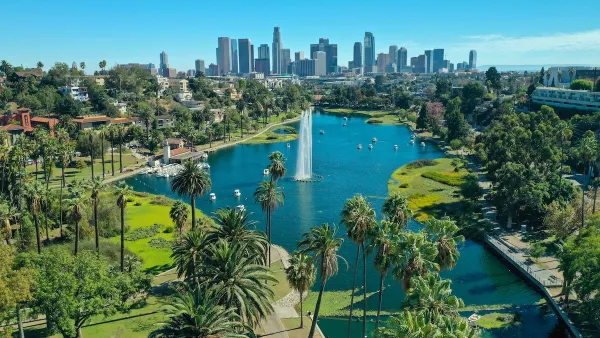
A Historic Investment in LA County’s Parks and Open Spaces
Los Angeles County has launched its largest-ever competitive grant program, investing $58 million to expand park access, enhance climate resilience, and support community-driven projects in the areas that need them most.

Innovative Park Agencies Receive National Recognition
The National Recreation and Park Association (NRPA) recently announced the recipients of this year’s awards for innovation in health and wellness, equity, conservation, and park design.

Planetizen Federal Action Tracker
A weekly monitor of how Trump’s orders and actions are impacting planners and planning in America.

Eastern Nebraska is running out of electricity
Data centers and electrification are straining eastern Nebraska’s grid, throttling economic development.

Study reveals best places in the U.S. for cycling, walking
New research from Streetlight Data examines bicycle and pedestrian miles per capita in the 100 largest U.S. cities by population.

DSA members accuse Mamdani of 'abandoning values' over housing redevelopment
New York City's mayor plans to replace about 2,000 units of public housing with private, mixed-income housing.

All sides of BRT debate unhappy with CDOT’s most recent move
The Colorado Department of Transportation is no longer considering center-running bus lanes for Colorado Boulevard.

Massachusetts bogs generate both power, and cranberries
Putting solar panels above farmland is one way Massachusetts is advancing toward its goal of net-zero carbon emissions by 2050.

FREE Course: Walkable City 1: Why Walkability?
After describing his path towards focusing on walkability as the essence of good planning, Jeff Speck marches through his five principal reasons for making more walkable places.
Reinventing Malls: Planning Alchemy—Turning Gray Fields Into Gold
The course focuses on the opportunities and imperatives that shape reinvention of mall sites.

City of Rosemead
Rutgers University, Edward J. Bloustein School of Planning and Public Policy
One Hundred Miles
University of Michigan School for Environment and Sustainability (SEAS)
Hunter College, City University of New York (CUNY)
The Architects Foundation
City of Cambridge
The Pocatello Development Authority
The Urban Renewal Agency of the City of Pocatello