Cultural changes and 'disruptions' created by the 'sharing' economy are challenging planners just as they're challenging their own competitors. Bill Fulton assesses the brave new world that might liberate planners—or befuddle them.


"Planners, for the most part, write and implement regulations that seek to plan for and control land uses. They do so for a variety of well-established reasons – ensuring that public health and safety are protected, but also helping to stimulate, shape, and channel the supply of built space so that the interests of a given community are balanced against the demands of the marketplace."
"But how can you possibly plan for and control land uses when every bedroom is a hotel room, and every dining room is a restaurant, and every coffee shop is an office, and conversely every office is a potential living room or dining room or bedroom?"
"The needs for parks, libraries, schools, and lots of other public facilities is all based on formulas tied to land uses. Residential densities determine the number of housing units (based on formulas tied to land use), which in turn determines the need for all these facilities (based on formulas that assume household size and composition), which in turn determines the need for both public investment and impact fees."
"In a certain way, this is pretty liberating for planners – kind of an extension of the form-based code movement, which focuses more on urban design than on the specific uses contained within buildings. Instead of micro-managing private development through regulation, California’s planners could rediscover the kind of planning that originated with Daniel Burnham and the Olmsteads: Focusing on created a beautiful and well-functioning public realm, around which the developers can build private projects that respond to the market."
Read the full story: The Tech Housing Crunch’s Fracking Dilemma

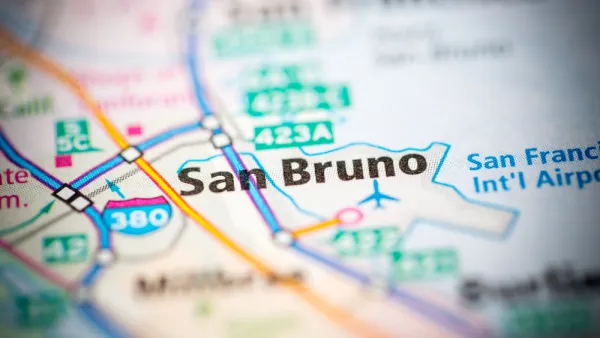
S.F. Bay Area City Says It Wants More Housing—But Votes Down Project
The project included everything San Bruno and residents asked for, and it would have helped the city make significant progress in addressing its growing housing crisis. Still, it was voted down.

California’s Inheritance Tax Break Is Helping Some Much More Than Others
An inheritance tax benefit, along with Proposition 13, has resulted in lower tax rates passing down through generations and billions of dollars in lost tax revenue.

San Francisco Board of Supervisors Propose 60-Day Hard Cap on Airbnb Rentals
Tensions between Airbnb and the city of San Francisco continue to mount as the city propose further restrictions on the service, even while the current restrictions are being challenged in court.

Planetizen Federal Action Tracker
A weekly monitor of how Trump’s orders and actions are impacting planners and planning in America.

Amtrak, CN end decades-long dispute with eight-year agreement
The new operating agreement establishes an updated framework for the companies to work together, including processes to resolve disputes.

Judges permit Denver to divert 77,000 acre feet from the Colorado River for reservoir expansion
Overuse and climate change have caused the Colorado River’s water levels to plummet.

Boston has spent millions making the Green Line more accessible — and there’s no end in sight
While the city has invested millions into expanding and adding platforms to the Green Line to make it more accessible, new train cars set to arrive next year will be too tall for disabled passengers to board without raising the current platforms.

Idaho may see an 18% drop in federal surface transit funding — the largest estimated cut in the US
Transit systems in rural communities are much more reliant on federal funding to provide their services.

How ‘post-disaster gentrification’ alters neighborhoods after natural calamities
After hurricanes, fires or other calamities, the original residents of a community are often replaced by younger, wealthier residents.

FREE Course: Walkable City 1: Why Walkability?
After describing his path towards focusing on walkability as the essence of good planning, Jeff Speck marches through his five principal reasons for making more walkable places.
Reinventing Malls: Planning Alchemy—Turning Gray Fields Into Gold
The course focuses on the opportunities and imperatives that shape reinvention of mall sites.

City of Wisconsin Rapids
Harvard University Graduate School of Design
KFH Group Inc.
The Architects Foundation
University of Cincinnati Online
The Pocatello Development Authority
The Urban Renewal Agency of the City of Pocatello