Greater Cleveland Habitat for Humanity has already been hard at work renovating homes and improving communities, with an ambitious goal to renovate 100 more homes in the next three years.


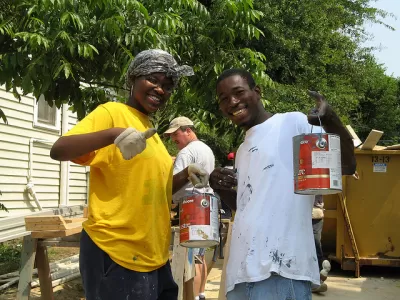
Mark Naymik reports on the recent efforts of Habitat for Humanity in the city of Cleveland, where the organization is renovating three homes in the neighborhood of Glenville, near University Circle on the city's East Side.
"The rehab of the homes is part of an ambitious agenda Habitat launched in 2013 to put its full resources into buying and renovating vacant properties in a targeted neighborhood rather than building more costly new homes on empty lots scattered across the city. The goal is to stabilize a street not yet lost completely to neglect and foreclosure by injecting homeowners almost overnight."
The three examples from Glanville are only part of Habitat for Humanity's Cleveland story—the organization has also renovated abandoned houses in the Slavic Village neighborhood, thanks in part to the donation of the properties by the Cuyahoga County Land Bank as well as Fairfax and more homes in Glenville.
In each neighborhood, Habitat for Humanity is strategic in its renovations so that homes can help raise the level of investment in the entire street or neighborhood. Naymik explains more about how the renovations achieve broader goals for the community:
"It's easy to spot Habitat homes on any street. The houses look new and often feature fully renovated porches, which the organization believes are crucial to building community because they become the eyes and ears on the street. In Slavic Village, several homes have rain gardens, which are fed by runoff from the downspouts, an attempt to divert the water from the homes' old foundations."
Read the full story: Refugees and Habitat for Humanity help fill Cleveland's abandoned homes and add stability to some streets

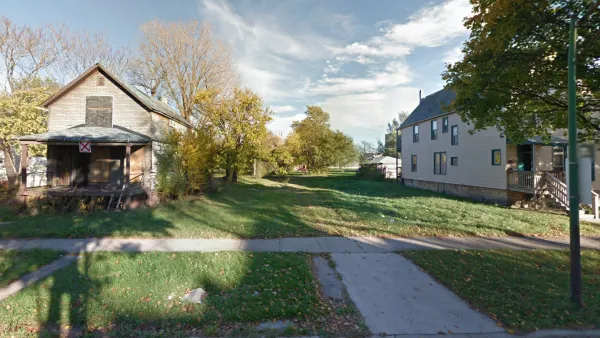
Property Taxes Due on Chicago's $1 Large Lots
So you bought a lot for $1 under the city of Chicago's Large Lots program. Expect your bills to go up a lot more than that measly sum.
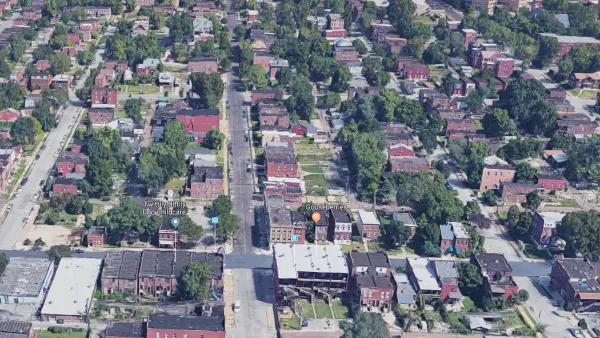
First-Of-Its-Kind Artist Housing Project Moving Forward in St. Louis
An innovative project in St. Louis' will revitalize the underinvested Gravois Park neighborhood while delivering housing options to creative types.
Transforming Vacant Properties Into Creative Hubs for Communities
The Renewal Project examines the work of the House Life Project in Indianapolis.

Planetizen Federal Action Tracker
A weekly monitor of how Trump’s orders and actions are impacting planners and planning in America.

The state-sanctioned urbicide of Austin
People don’t kill cities. Freeways do.

Colorado’s Largest Data Center Could Rise Next to Homes — Without a Public Hearing
The proposed campus would consume 11 times the power of Denver International Airport; as it has across the country, opposition mounts.

Judges permit Denver to divert 77,000 acre feet from the Colorado River for reservoir expansion
Overuse and climate change have caused the Colorado River’s water levels to plummet.

Amtrak, CN end decades-long dispute with eight-year agreement
The new operating agreement establishes an updated framework for the companies to work together, including processes to resolve disputes.

Raised interest rates may kill financially vulnerable construction projects
The chief economist at ConstructConnect warns that if construction project owners are negatively impacted by the raised rates, it could result in delayed payments to contractors.

FREE Course: Walkable City 1: Why Walkability?
After describing his path towards focusing on walkability as the essence of good planning, Jeff Speck marches through his five principal reasons for making more walkable places.
Reinventing Malls: Planning Alchemy—Turning Gray Fields Into Gold
The course focuses on the opportunities and imperatives that shape reinvention of mall sites.

Greater Baltimore Committee
Eagle County Government
Harvard University Graduate School of Design
The Architects Foundation
University of Cincinnati Online
The Pocatello Development Authority
The Urban Renewal Agency of the City of Pocatello
Journal of the American Planning Association