Downtown San Diego's East Village neighborhood shares traits with San Francisco's SOMA, circa 1990s. However, there are competing visions for the area: academic and high tech vs. stadium and convention center expansion.


San Diego has been embroiled in a widely publicized effort to keep its professional football team, the Chargers, from moving to Carson in Los Angeles County in pursuit of a bigger and better stadium (and perhaps a bigger market). In an effort to keep the team, San Diego's mayor has proposed a new stadium on the site of the old stadium, which would require voter approval to fund the city's share of construction costs.
At the same time, the city has been struggling with expanding its convention center. A recent initiative would have the city raise its transit occupancy tax to fund a non-contiguous convention center expansion (disfavored by expansion supporters) on an East Village site, and to limit siting of any new football stadium to East Village.
In an op-ed, several leading land use specialists criticized the East Village stadium and convention center proposal, noting the strategic value of the proposed site and the burgeoning mix of academia, residential, and creative incubator development in the area. The op-ed recommends that the city "not even think about dropping the neutron bomb of a stadium on East Village."
Land use attorney Bill Adams followed up the op-ed with his own, suggesting the city fully adopt a vision consistent with the academic and high tech green shoots already blossoming in the East Village. Moreover, Adams proposes that the city dedicate the site proposed for the stadium and convention center expansion for construction of a university campus, and marshall its stadium resources to attracting a major university satellite campus.
The East Village has great synergy for an academic use. The new Central Library, an expanded City College, the New School of Architecture, the Woodbury School of Architecture, Thomas Jefferson School of Law, the Urban Discovery Academy, e3 Civic High School (in the Library), the IDEA District, dense rental apartment projects, the city's highest density zoning, and hundreds of acres of the most valuable land in the City laying fallow as surface parking or weedy lots add up to a unique opportunity for creating an academic and economic powerhouse - located downtown but regional in impact. Yet San Diego remains the only major metropolitan downtown without a major university presence.
. . .
Imagine what could be accomplished if some of the millions being suggested for subsidizing an NFL stadium were instead used to attract a satellite campus of an Ivy League or other major university to the East Village -- such as recently happened in New York with Cornell's Tech Campus project on Roosevelt Island or in San Francisco with UCSF Medical School in Mission Bay.
Adams goes on to describe the unique "education-friendly infrastructure" of East Village and argues that pursuing a major university satellite campus for the site has far more economic and cultural benefit than a stadium or convention center expansion.

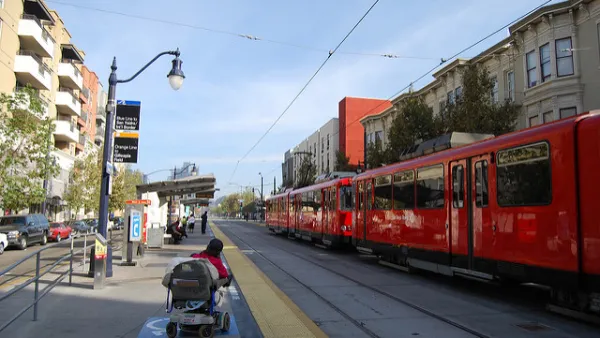
San Diego Activists Plan a Pedestrian Promenade and 'Nudillo'
Activists organized to save their downtown San Diego neighborhoods from the NFL Chargers' stadium proposal. Their defense strategy? A fine-grained community plan with no stadium. In the process, they came upon the idea of a promenade and a "Nudillo."
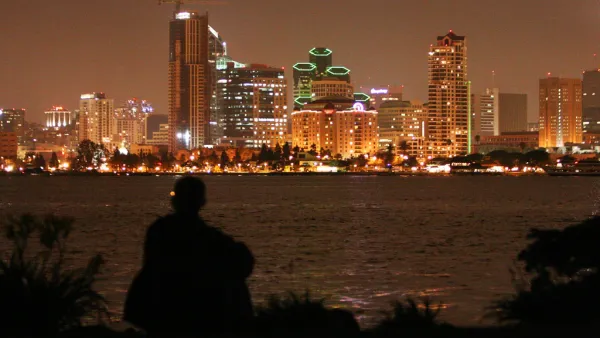
A Peek at the Future Downtown San Diego Without a New Charger Stadium
With two November ballot initiatives proposing to rezone a large part of downtown San Diego for a combined NFL stadium and convention facility, the community and a team of architects worked furiously to complete a more urban vision for the site.

Op-ed: Federal austerity is funding what kills us
Tracing the backstory of the last year of cuts to multimodal transportation reveals an alarming definition of road safety that only serves one mode.

The state-sanctioned urbicide of Austin
People don’t kill cities. Freeways do.

US to reduce Colorado River water deliveries to Mexico
A new Colorado Treaty amendment reduces Mexico’s Colorado River water allocation by 250,000 acre feet.

New Jersey’s second-largest city bans standalone data centers
Jersey City will continue to allow co-location facilities, such as those meant for research institutions that store their own data.

Amtrak not solely to blame for New Jersey commuter rail's unreliability, report finds
A new study from the Garden State Initiative found that NJ Transit’s budget grew 20% across a 4 year period, but reliability declined significantly over the same period.

EPA erases limits on planet-warming pollution from power plants
Under Monday’s plan, power plants would still have some limits on how much mercury, arsenic and other contaminants they can emit.

Phoenix announces new on-demand transit service, more frequent RAPID buses
Both new services will launch in October, and are part of Phoenix's Project Effective Access Solutions for Easing Congestion.

FREE Course: Walkable City 1: Why Walkability?
After describing his path towards focusing on walkability as the essence of good planning, Jeff Speck marches through his five principal reasons for making more walkable places.
Reinventing Malls: Planning Alchemy—Turning Gray Fields Into Gold
The course focuses on the opportunities and imperatives that shape reinvention of mall sites.

Eagle County Government
Harvard University Graduate School of Design
Nashville Planning Department
The Architects Foundation
University of Cincinnati Online
The Pocatello Development Authority
The Urban Renewal Agency of the City of Pocatello
Journal of the American Planning Association