The big, contentious question of contemporary downtowns is under consideration in Dallas: Is there too much parking or not enough parking?


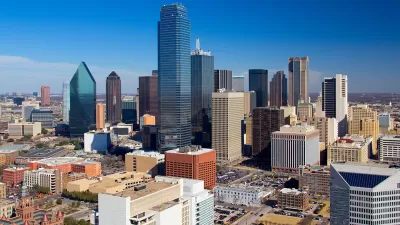
Robert Wilonsky recently reported that the city of Dallas is seeking consultants to study Downtown Dallas' parking needs and develop a plan to meet parking demands. According to Wilonsky, "[t]he request for qualifications…blames a lack of parking on some companies choosing to move to the suburbs rather than the city center." The RFQ elaborates on how the rebirth of downtown "into a globally competitive urban center has placed strains on the ability to meet parking demands and expectations, resulting in some desired investment and development choosing to forego downtown Dallas for locations in outlying suburban areas."
The parking plan follows from the update of the Downtown Dallas 360 plan, approved in 2011 and currently amidst an update. Wilonsky notes that the city is also underway with a study examining on-street parking and about to launch another parking study in the Bishop Arts District neighborhood.
Enter Mark Lamster, Dallas Morning News architecture critic, who provides his critical take on the trends favoring parking in downtown: "This is not the best use for such precious spaces with the urban center." Lamster is bluntly skeptical that the city's new study will achieve anything other than more reinforcement for the parking status quo: "What it will do is reinforce the cycle of looping logic that has bred the very problem it would resolve. Because downtown Dallas doesn’t principally have a parking problem. It has a downtown Dallas problem, and the parking situation is only an exacerbating consequence of that reality."
Lamster provides a long list of specific shortcomings in the public realm of downtown to elaborate that point that it will take much more than a parking study to understand parking in Dallas.
Peter Simek follows Lamster's commentary with some of his own, including the additional point that the city's downtown buildings suffer from historically low vacancy rates, which creates a catch-22 of parking demand.
Read the full story: Dallas is ready to pay someone to find out if the city has enough downtown parking spaces


Planning Trends to Watch in 2023
The days and weeks since the arrival of Covid-19 have been filled with so much noise about the future, it’s been difficult to distinguish between big stories and frivolous distractions. Planetizen is here to help.
The Once-in-a-Generation Opportunity to Remake Downtown
Urban cores around the country were transforming into live, work, and play destinations before the pandemic. The pandemic was a setback for this transformation, but it could also be a rare opportunity. It’s up to city leadership to seize it.
Development Code, Future Land Use Map Updates Coming to Dallas
The ForwardDallas initiative is attempting for the Holy Grail of planning: development certainty.

Planetizen Federal Action Tracker
A weekly monitor of how Trump’s orders and actions are impacting planners and planning in America.

‘Going backwards:’ Baltimore mayor, students rally against state's transit funding plan
Maryland's proposed six-year plan provides no funding for Baltimore’s BMORE bus program and reduces its road maintenance funding.

Detroit to transform waterfront with $2.2 billion investment
Developers will convert about 18 acres of unused parking lot space into civic spaces.

Newsom vetoes high-speed rail supervision bill after agency receives condemnatory audit
The audit found the CHSRA approved almost $600,000 in unallowable travel expenses.

Nation sees first electric plane-boat hybrid take off in public demo
The Viceroy Seaglider can fly at speeds of 180mph for up to 180 miles.

One of nation’s poorest counties to receive $6 billion data center
The developers estimate the project will create 200 permanent jobs and 1,000 temporary construction jobs.

FREE Course: Walkable City 1: Why Walkability?
After describing his path towards focusing on walkability as the essence of good planning, Jeff Speck marches through his five principal reasons for making more walkable places.
Reinventing Malls: Planning Alchemy—Turning Gray Fields Into Gold
The course focuses on the opportunities and imperatives that shape reinvention of mall sites.

City of Thousand Oaks
City of Wisconsin Rapids
Harvard University Graduate School of Design
The Architects Foundation
University of Cincinnati Online
Northern Illinois Transit Authority (NITA)
The Pocatello Development Authority
The Urban Renewal Agency of the City of Pocatello