Bruce Katz has an idea: "A year out from next year’s presidential election, let’s dispel the pervasive myth that the federal government runs the country."


According to Bruce Katz, partisan gridlock are forcing state and local governments into new, more powerful roles in setting policy for the country. Katz cites infrastructure and education, two failing responsibilities, in many respects, that will likely be improved by political powers not located in Washington, D.C. As an example of local governments achieving innovative success in the area of infrastructure, Katz credits Denver, San Diego, and Dallas for "making economy-shaping investments in infrastructure and public space through innovative partnerships and funding mechanisms."
Katz notes other sectors—namely telecommunications, clean energy, and public health—where the federal role in funding and finance is also limited before laying out a new "federalist roadmap" that allows the cities a more prominent role in the governance of the country.
After positing three characteristics of the new federalist roadmap, Katz makes this concluding appeal:
"We are at a cross roads. Neither the mid-20th century model of 'made in Washington' nor the late 20th century model of 'get it out of Washington' serve the country well. We need a reliable federal partner and a federalism that reflects how the country actually operates. Presidential candidates, are you listening? "
Read the full story: Toward a city-led federalism
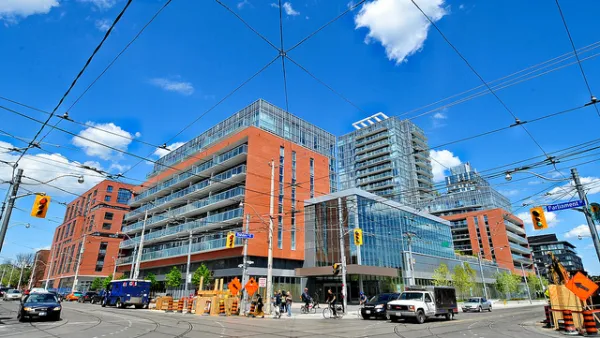
Canada Is Looking Better and Better
Alan Mallach unpacks a remarkable project currently underway in Toronto, suggesting that sometimes higher, rather than lower, density may be the best way to go.
A New Federalism Needed to Support America's Modern Metropolitan-Oriented Economy
In an essay adapted from their new book, Jennifer Bradley and Bruce Katz examine America's traditional 'dual sovereignty' federalism. They argue that metropolitan areas should play a greater role in governance through a collaborative federalism.
States Take Action on Foreclosures While Federal Government Stumbles
Without a clear federal plan to counteract the swath of foreclosures sweeping across the country, state governments are finding ways to reduce the local impacts.

Desperate measures: Advocates weigh draining Lake Powell to fill Colorado River
Draining the reservoir could reduce evaporation losses by a couple hundred thousand acre-feet.

Eastern Nebraska is running out of electricity
Data centers and electrification are straining eastern Nebraska’s grid, throttling economic development.

Move over, LA: St. Louis gears up for Olympics, invests millions in downtown redevelopment
The Missouri city will host the 2028 Olympic soccer group stage and knockout matches.

Mass. votes against statewide minimum lot size for single-family homes
Over 2 million residents voted on Question 7; it was decided by just over 30,000 votes.

Maryland’s $15 billion bridge project gains key approval
The Maryland Transit Authority said the project will create over 60,000 jobs and add $23 billion to the local economy.

‘No clear next steps’ for Chicago's permanent festival grounds
Eleventh Ward Ald. Nicole Lee has suggested Soldier Field as a possible location for the permanent event space.

FREE Course: Walkable City 1: Why Walkability?
After describing his path towards focusing on walkability as the essence of good planning, Jeff Speck marches through his five principal reasons for making more walkable places.
Reinventing Malls: Planning Alchemy—Turning Gray Fields Into Gold
The course focuses on the opportunities and imperatives that shape reinvention of mall sites.

City of Rosemead
Rutgers University, Edward J. Bloustein School of Planning and Public Policy
One Hundred Miles
University of Michigan School for Environment and Sustainability (SEAS)
Hunter College, City University of New York (CUNY)
The Architects Foundation
City of Cambridge
Montrose County
The Pocatello Development Authority