Much has been made of New York's current boom in high-rise construction. A new interactive feature by the Council of Tall Buildings and Urban Habitat allows for some historic perspective on the city's penchant for building skyward.


Linda Poon shares news of a new interactive timeline from the Council of Tall Buildings and Urban Habitat (CTBUH), "which shows the rollercoaster-like progression of NYC’s skyscraper construction." The timeline also, according to Poon, "connects some of the most active and inactive years of construction with major social and political events in history."
The article concentrates especially on insights gleaned from the interative timeline into years like 1931 ("one of the most active years for building) and the 1970s. And, of course, there's perspective to be gained on the present day:
"Today, the construction of skyscrapers is once again booming, fueled largely by the rise in luxury residential construction. The clusters of blue dots—representing residential buildings—increases significantly after the 1960s. An accompanying pie chart shows that, of the 826 buildings included in the timeline, almost half are for housing."
Read the full story: Charting the Booms and Busts of NYC's Skyscraper History
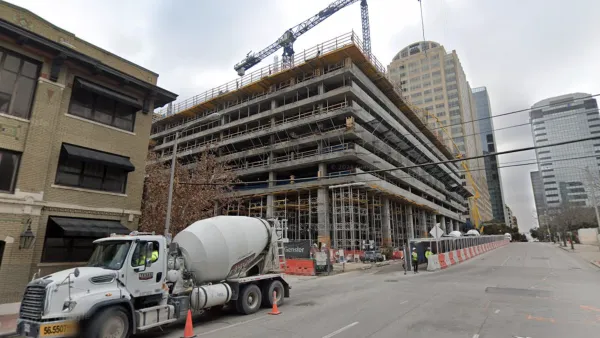
Austin's Tallest Tower Rising Quickly
Sixth and Guadalupe, which will top out at 875 feet, will soon be crowned the tallest building in Austin, and the fifth-tallest building in Texas.

20 Years After 9/11: The 'Age of Skyscrapers' Is Nowhere Near Over
Despite predictions that the events of September 11, 2001 would be the end of skyscrapers, U.S. cities are building more tall buildings than ever.
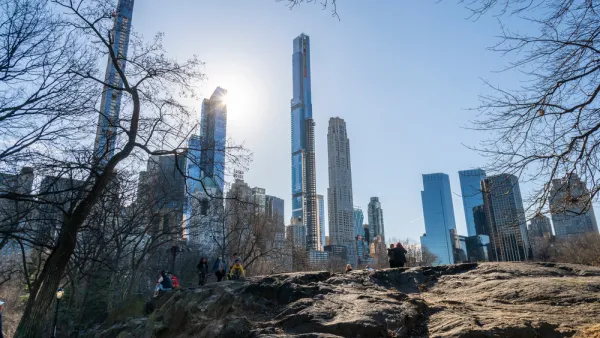
World's Tallest Residential Building Nears Completion in Manhattan
Central Park Tower, coming soon to New York City's "Billionaires' Row" was designed by Adrian Smith + Gordon Gill architecture.

Planetizen Federal Action Tracker
A weekly monitor of how Trump’s orders and actions are impacting planners and planning in America.

California plans to bury El Niño’s downpour
If the state plays its cards right, it may be able to store a billion acre-feet of El Niño’s water in aquifers.

Desperate measures: Advocates weigh draining Lake Powell to fill Colorado River
Draining the reservoir could reduce evaporation losses by a couple hundred thousand acre-feet.

Los Angeles just elected an urban planner as its mayor
Transportation analysts are optimistic that Raman will be more aggressive in addressing transit issues than Bass.

Mamdani’s pied-à-terre tax survives legal challenge
A panel of judges found that the plaintiffs failed to demonstrate injury as a result of New York City's implementation of the tax.

Eastern Nebraska is running out of electricity
Data centers and electrification are straining eastern Nebraska’s grid, throttling economic development.

FREE Course: Walkable City 1: Why Walkability?
After describing his path towards focusing on walkability as the essence of good planning, Jeff Speck marches through his five principal reasons for making more walkable places.
Reinventing Malls: Planning Alchemy—Turning Gray Fields Into Gold
The course focuses on the opportunities and imperatives that shape reinvention of mall sites.

City of Rosemead
Rutgers University, Edward J. Bloustein School of Planning and Public Policy
One Hundred Miles
University of Michigan School for Environment and Sustainability (SEAS)
Hunter College, City University of New York (CUNY)
The Architects Foundation
City of Cambridge
Montrose County
The Pocatello Development Authority