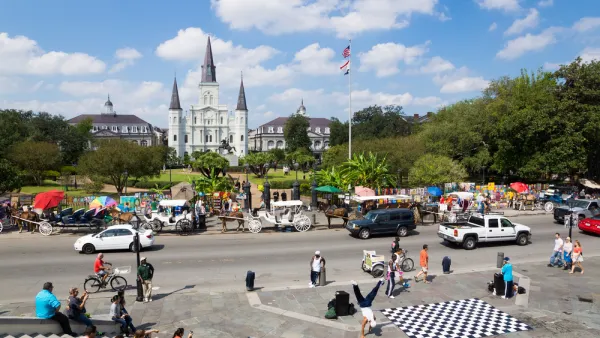
Are there too many urban parks and plazas? If not, why do some fail? In this collaborative article, several urban planning gurus from different cities respond to these questions. They provide both shared and unique perspectives.


Jane Jacobs preferred the "ballet of the good city sidewalk" over urban parks. In fact, she was critical of many parks, as they existed in 1950s Robert Moses shaped New York City. Much has changed in park design since Jane Jacobs wrote The Death and Life of Great American Cities, and yet many of her prescriptions and warnings are as relevant as ever. In this article, five urban planning gurus—three from San Diego, one from NYC, and one from Portland OR—give their views about what makes a good urban park, both in general and in their particular city. The article concludes:
Design, location, context, programming, maintenance, unified planning, and other factors mean everything. . . Much has been learned from and since Jane Jacobs’ milestone of urban understanding about park design and location but urban parks do still on occasion fail. Jacobs warned against planning on the basis of statistics or metrics (“disorganized complexity”), e.g., one park per so many people or per so many square miles. A successful park depends on understanding the many interrelated elements in a neighborhood and successfully planning for them – including funding for maintenance and operation.
Read the full story: Are cities building too many parks and plazas in their downtowns? The experts weigh in . . .
Bringing Back America’s Town Squares
Digital connection is no substitute for the vitality and community created by open, pleasant public squares and plazas.

Portland Extends Pandemic Public Space Programs
PBOT will continue two highly successful COVID-era programs that allowed businesses and community groups to repurpose public spaces for pedestrian-oriented uses and engage with customers in safe, accessible outdoor settings.

How Urban Design Affects Children's Cognitive Development
A European study suggests that good urban design can affect cognitive and motor function development in young children.

Planetizen Federal Action Tracker
A weekly monitor of how Trump’s orders and actions are impacting planners and planning in America.

California plans to bury El Niño’s downpour
If the state plays its cards right, it may be able to store a billion acre-feet of El Niño’s water in aquifers.

Desperate measures: Advocates weigh draining Lake Powell to fill Colorado River
Draining the reservoir could reduce evaporation losses by a couple hundred thousand acre-feet.

Mamdani’s pied-à-terre tax survives legal challenge
A panel of judges found that the plaintiffs failed to demonstrate injury as a result of New York City's implementation of the tax.

Eastern Nebraska is running out of electricity
Data centers and electrification are straining eastern Nebraska’s grid, throttling economic development.

Seattle passes record-breaking transit services expansion
Proposition 1 will double the city’s transit tax to add 95,000 more bus trips and preserve 180,000 bus trips annually.

FREE Course: Walkable City 1: Why Walkability?
After describing his path towards focusing on walkability as the essence of good planning, Jeff Speck marches through his five principal reasons for making more walkable places.
Reinventing Malls: Planning Alchemy—Turning Gray Fields Into Gold
The course focuses on the opportunities and imperatives that shape reinvention of mall sites.

City of Rosemead
Rutgers University, Edward J. Bloustein School of Planning and Public Policy
One Hundred Miles
Hunter College, City University of New York (CUNY)
The Architects Foundation
University of Cincinnati Online
City of Cambridge
Montrose County
The Pocatello Development Authority