With statistics showing that fewer than half of Americans know their neighbors, bringing neighborliness to neighborhoods remains a challenge for urban planners.


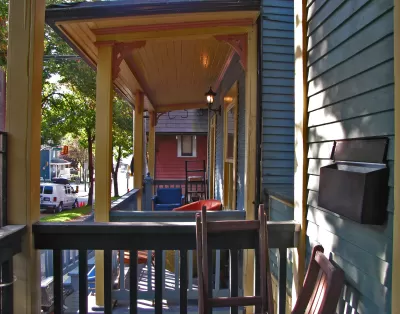
Danielle Braff writes in The Chicago Tribune on the continued growth of new urbanist-style neighborhoods as people seek out greater connections with their neighbors. Focusing on Meadow Ridge, a gated community of 130 homes in Chicago’s Northbrook neighborhood, Braff speaks with Patrick Coveny of the Home Builders Association of Greater Association about what attracts people to places like Meadow Brook. "Right now, people are in their own homes, and we're not doing work in their yard, we're not cutting our own lawns like we used to do — and that's how we used to meet our neighbors," Coveny said.
Architects have responded by reintroducing the front porch to homes as a place where neighbors could interact. Sarah Susanka, an architect and author, sees the value of the front porch in building connections.
"We have become so separate from one another," she said. "We get our groceries on our phones without talking, but we have such a desire to interact. There is such a surge for a community, we need to see each other," Susanka said. "The virtual connection is wonderful, but there's something else that happens when we run into each other, and that's what we're longing for right now. There's a movement that's a creation of communities."
FULL STORY: How housing design can make for better neighbors

How the Built Environment Impacts Public Health
New research sheds light on how the brain responds to urban environments and architecture.
Reassessing New Urbanism
A thematic issue of the peer reviewed journal Urban Planning provides a framework for reassessing New Urbanism.
Design Thinking Needs a Broader Perspective
A design-focused study of mode choice doesn’t consider the many ways people interact with and travel through urban environments.

Planetizen Federal Action Tracker
A weekly monitor of how Trump’s orders and actions are impacting planners and planning in America.

The state-sanctioned urbicide of Austin
People don’t kill cities. Freeways do.

US to reduce Colorado River water deliveries to Mexico
A new Colorado Treaty amendment reduces Mexico’s Colorado River water allocation by 250,000 acre feet.

5 New England states march closer to 800 megawatt wind energy project
Securing federal approval for the project may be complicated under the Trump administration, which has historically been hostile towards domestic wind power.

Baltimore to break ground on $50 million Transit Priority Project
The project will bring faster bus trips, safer streets and better bike connections to Baltimore.

Airbnb launches $250 million 'last-dollar financing' housing accelerator, makes first investment in Austin
The company will put $6.4 million towards affordable housing development in Texas’ capital.

FREE Course: Walkable City 1: Why Walkability?
After describing his path towards focusing on walkability as the essence of good planning, Jeff Speck marches through his five principal reasons for making more walkable places.
Reinventing Malls: Planning Alchemy—Turning Gray Fields Into Gold
The course focuses on the opportunities and imperatives that shape reinvention of mall sites.

Eagle County Government
Harvard University Graduate School of Design
Nashville Planning Department
The Architects Foundation
University of Cincinnati Online
The Pocatello Development Authority
The Urban Renewal Agency of the City of Pocatello
Journal of the American Planning Association