A group of passionate rowers deserve some of the credit in the remarkable comeback story of Cleveland's Cuyahoga River.


Daniel J. McGraw identifies a key partner in the process of reimagining Cleveland's Cuyahoga River. "Clevelanders are rethinking the waterway — and rowers deserve some of the credit," writes McGraw. "The attention they’ve helped to shift toward the river has helped spawn the creation of a riverfront park, spurred economic development in an empty industrial area of Cleveland, and helped change the regional consciousness that the waterways — Lake Erie and the Cuyahoga River, among others — in Northeast Ohio are fundamental assets…"
Rowers, according to the article began their fight by bringing attention to public access to the river. Those early efforts, according to McGraw, are paying off with more momentum in recent years: "Cleveland Metroparks is currently constructing bike trail paths along the river, and Rivergate Park will be the hub for many of these trails that link areas south of Cleveland to Lake Erie. Numerous businesses have relocated to once-empty warehouse space."
Read the full story: How Rowers Got Cleveland to Rethink a River
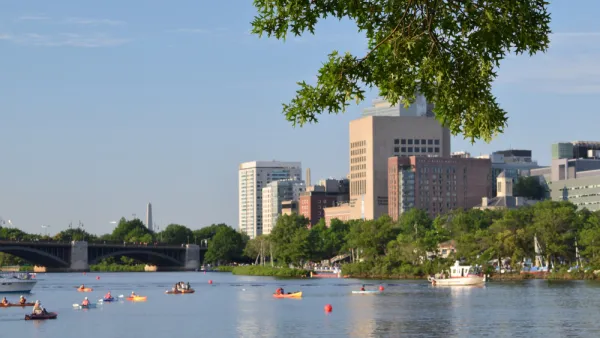
Urban Rivers Everywhere Follow the Cuyahoga's Lead
On the 50th anniversary of the Cuyahoga River catching fire in Cleveland, it's a good time for urban river keepers everywhere to reevaluate their work and redouble their efforts to make safe and healthy rivers for everyone.
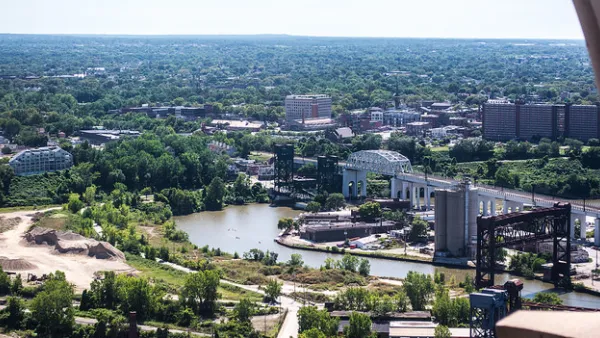
Paddling the Cuyahoga River in Cleveland, 50 Years After in Burned
One of the great environmental success stories in the nation, manifested by the joy of paddling a river.
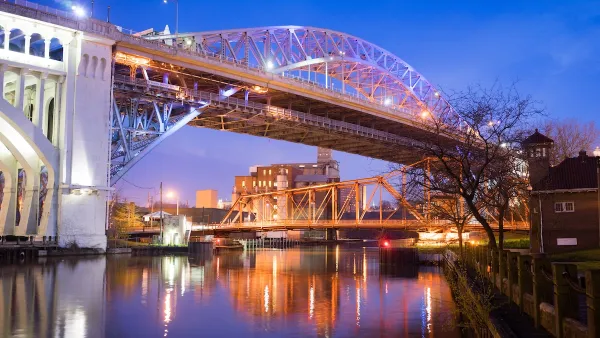
Defunct Streetcar Bridge Could Become Cleveland’s ‘Low Line’
The city will develop a plan to transform an unused streetcar deck on the Veterans Memorial Bridge into a connector for bikes and pedestrians as well as a welcoming public space.

Planetizen Federal Action Tracker
A weekly monitor of how Trump’s orders and actions are impacting planners and planning in America.

California plans to bury El Niño’s downpour
If the state plays its cards right, it may be able to store a billion acre-feet of El Niño’s water in aquifers.

Desperate measures: Advocates weigh draining Lake Powell to fill Colorado River
Draining the reservoir could reduce evaporation losses by a couple hundred thousand acre-feet.

Mamdani’s pied-à-terre tax survives legal challenge
A panel of judges found that the plaintiffs failed to demonstrate injury as a result of New York City's implementation of the tax.

Eastern Nebraska is running out of electricity
Data centers and electrification are straining eastern Nebraska’s grid, throttling economic development.

Seattle passes record-breaking transit services expansion
Proposition 1 will double the city’s transit tax to add 95,000 more bus trips and preserve 180,000 bus trips annually.

FREE Course: Walkable City 1: Why Walkability?
After describing his path towards focusing on walkability as the essence of good planning, Jeff Speck marches through his five principal reasons for making more walkable places.
Reinventing Malls: Planning Alchemy—Turning Gray Fields Into Gold
The course focuses on the opportunities and imperatives that shape reinvention of mall sites.

City of Rosemead
Rutgers University, Edward J. Bloustein School of Planning and Public Policy
One Hundred Miles
University of Michigan School for Environment and Sustainability (SEAS)
Hunter College, City University of New York (CUNY)
The Architects Foundation
City of Cambridge
Montrose County
The Pocatello Development Authority