Local officials, planners, and other civic leaders have joined together to look at how the city can bring neighborhoods split by freeways back together again.


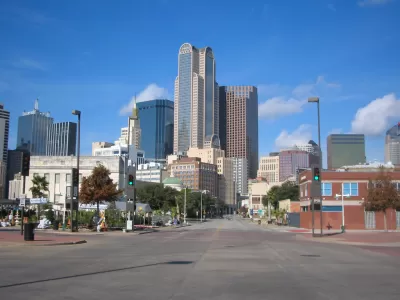
Brandon Formby reports in The Dallas Morning News on a new program lead by the Texas Department of Transportation in partnership with local planners and civic leaders. The goal of the new program called CityMAP is to produce a menu of option for how the city can begin to rebuild, tweak, or replace existing freeways surrounding downtown Dallas to overcome the freeway as a physical barrier that has separated the downtown core from surrounding neighborhoods. An existing example for innovative thinking is the city's Klyde Warren Park, built on a deck over a portion of the Woodall Rodgers Freeway, and opened in 2012. The park has become a popular spot for families and recreationists. However, future transit improvements, including the construction of a high-speed rail station and expansion of the rapid transit system through downtown, have also spurred new thinking for increasing connectivity throughout the city.
"The goal isn’t just to create more deck parks, though more could be in store. There are deeper hopes that updating major infrastructure in the urban core will restitch neighborhoods, spur developments with a dense mix of residences and job centers and give thousands of people the option to ditch their cars altogether."
Three meetings will be held in October and November to get public input on new ideas and potential solutions to create a more integrated downtown core, with the recognition that beyond just a destination, downtown has grown into a thriving live-work community.
Read the full story: CityMAP planners envision future of downtown Dallas’ aging highways
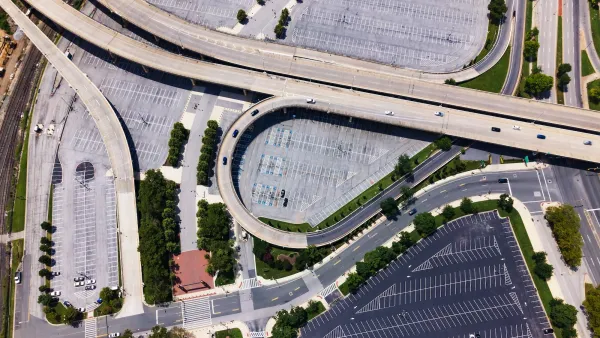
New Tool Uncovers Exact Costs of Downtown Highways
A new research tool can help cities calculate the economic potential that could be unlocked by replacing highways with other uses.
Dallas City Council to Vote on Controversial Freeway Trenching Plan
A proposal to bury part of Interstate 345 in a 65-foot trench is the latest in a debate that has lasted more than ten years as the freeway reaches the end of its useful life.
Opinion: Hit the Brakes on Dallas Freeway Plan
A proposal to bury a Dallas freeway may not be the best way forward for the area’s residents.

Desperate measures: Advocates weigh draining Lake Powell to fill Colorado River
Draining the reservoir could reduce evaporation losses by a couple hundred thousand acre-feet.

Eastern Nebraska is running out of electricity
Data centers and electrification are straining eastern Nebraska’s grid, throttling economic development.

Move over, LA: St. Louis gears up for Olympics, invests millions in downtown redevelopment
The Missouri city will host the 2028 Olympic soccer group stage and knockout matches.

Mass. votes against statewide minimum lot size for single-family homes
Over 2 million residents voted on Question 7; it was decided by just over 30,000 votes.

Maryland’s $15 billion bridge project gains key approval
The Maryland Transit Authority said the project will create over 60,000 jobs and add $23 billion to the local economy.

‘No clear next steps’ for Chicago's permanent festival grounds
Eleventh Ward Ald. Nicole Lee has suggested Soldier Field as a possible location for the permanent event space.

FREE Course: Walkable City 1: Why Walkability?
After describing his path towards focusing on walkability as the essence of good planning, Jeff Speck marches through his five principal reasons for making more walkable places.
Reinventing Malls: Planning Alchemy—Turning Gray Fields Into Gold
The course focuses on the opportunities and imperatives that shape reinvention of mall sites.

City of Rosemead
Rutgers University, Edward J. Bloustein School of Planning and Public Policy
One Hundred Miles
University of Michigan School for Environment and Sustainability (SEAS)
Hunter College, City University of New York (CUNY)
The Architects Foundation
City of Cambridge
The Pocatello Development Authority
The Urban Renewal Agency of the City of Pocatello