A closer look at the data of a study revealing the number of trees on the planet shows several ways to compare and contrast the relative resources, in the form of trees, of countries around the world.


Chris Mooney follows up on that "dramatic study" released earlier this month finding a total of 3 trillion trees living on the planet. "But much of the coverage missed what may have been the most fascinating new data of all," says Mooney, "provided in a supplement to their broader study."
"There, the scientists calculated comprehensive estimates of the numbers of trees in each country of the world, and how that relates to the country’s physical size, population size and more."
Mooney postis that this data allows a new understanding of each country's "tree wealth" or "tree resources"—given the many environmental and economic benefits of trees.
Mooney goes on to describe the findings of the total tree count ranking provided by the study, which benefits countries of massive size. Russia leads the rankings, followed by Canada, and the United States is fourth. Noting how land size skews these rankings, Mooney also examines the tree density metric. Finland is the country with the most trees per kilometer. Mooney also examines trees per person and trees per GDP.
Read the full story: The countries of the world, ranked by their ‘tree wealth’
Technology Enables a New Understanding of the World's 3.04 Trillion Trees
A news study, combining satellite imagery and field study, dramatically increases the estimated trees in the world. What has not changed: how quickly humans are killing those trees off.

The Cost of a Well-Maintained Urban Tree Canopy Is Actually Pretty Cheap
In terms of its public health benefits, a flourishing tree canopy is practically priceless.
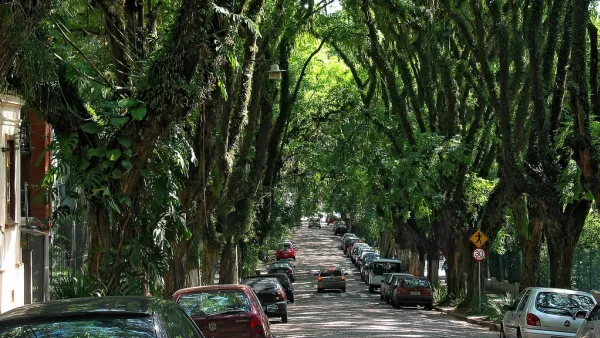
How Neighborhood Trees Improve Public Health
New research reveals more of the details of how trees provide therapeutic effects for humans.

Planetizen Federal Action Tracker
A weekly monitor of how Trump’s orders and actions are impacting planners and planning in America.

Washington state to charge fee to drivers with fuel-efficient cars
Revenue from the fee will go towards supporting the state’s highways.

Illinois considers spending $1 billion in taxpayer money on data center
A quantum computing campus and data center are currently under construction in Chicago.

Did data centers change how voters cast their ballots?
Texas, Ohio, and Georgia all flipped party control. But in rural counties, the effect of local data centers was mixed.

Amtrak invests in eight new Airo trainsets
The new trainsets will begin serving passengers in 2031.

HUD to end aid for mixed-immigration-status households
The new rule is projected to impact 80,000 people, nearly half of whom are children.

FREE Course: Walkable City 1: Why Walkability?
After describing his path towards focusing on walkability as the essence of good planning, Jeff Speck marches through his five principal reasons for making more walkable places.
Reinventing Malls: Planning Alchemy—Turning Gray Fields Into Gold
The course focuses on the opportunities and imperatives that shape reinvention of mall sites.

City of Charlotte
City of Rosemead
Rutgers University, Edward J. Bloustein School of Planning and Public Policy
University of Michigan School for Environment and Sustainability (SEAS)
Hunter College, City University of New York (CUNY)
The Architects Foundation
University District Partnership