A seven-year-old light rail line has beaten ridership projections and transformed neighborhoods in Phoenix. Now, one of the nation's most sprawling cities considers where to expand the system—and how to pay for it.


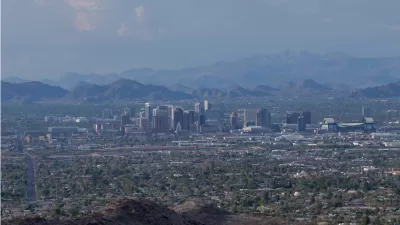
In a risky move for a mayor in a largely conservative state, Phoenix Mayor Greg Stanton is asking voters to approve a 35-year sales tax increase. He's promising big, tangible returns: funds will contribute to the expansion of Phoenix's light rail system, which currently measures 20 miles, with a 3-mile extension into Mesa underway. Stanton is pushing expansion in the face of what many consider the line's overwhelming success.
"Today passengers take nearly 44,000 trips on light rail on a typical weekday, already beating the local transit agency’s estimates for ridership in 2020. Long-neglected neighborhoods are experiencing new life, and major employers credit transit for their decision to add new jobs in the region."
"(Mayor Greg) Stanton argues that the strategy has worked so well that it should be rolled out to many more neighborhoods. 'It’s about more than getting people from point A to point B. The single most powerful tools we have to drive economic development are quality streets and robust public transit,' Stanton said while pitching his new transportation plan this spring. He argued that the increased rider capacity would help prepare Phoenix for further population growth and link more of the area’s community colleges and universities. 'It is the most comprehensive transportation plan in our city’s history,” he said. 'It’s forward-thinking. It’s ambitious. And the city council and I will ask voters to approve this plan in August.'"
Planners seem to have picked a good route to lure Phoenix residents out of their cars—and to attract those who don't have cars in the first place. Arizona State University contributes a large number of riders. Many have also discovered the line en route to events downtown. As well, at least one major company has relocated downtown, and local government has accounted for much of the new development along the line.
"Sports events are a major draw for light rail passengers, and downtown sports facilities, built well before the light rail, represent another huge public investment. Chase Field, where the Arizona Diamondbacks play baseball, was built using sales tax revenues and is owned by Maricopa County; U.S. Airways Center, home of the Phoenix Suns basketball team, is owned by the city. Meanwhile, the city-owned Sky Harbor Airport, which draws 31,000 employees along with airline passengers, is improving the connection between the airport rail station and its terminals with a new $1.6 billion automated train."
While light rail still rouses critics who say it is too expensive, those objections have quieted somewhat.
"Light rail is not nearly as controversial in Phoenix as it was a decade or so ago, when several ballot measures to fund it were defeated. “There was a loud roar back in the early 2000s” when it was being proposed, says Todd Sanders, the president and CEO of the Greater Phoenix Chamber of Commerce. 'Today you really don’t hear it. More and more you hear people wanting to get light rail, in the next phase, into their communities.'"
Read the full story: How Car-Centric Cities Like Phoenix Learned to Love Light Rail

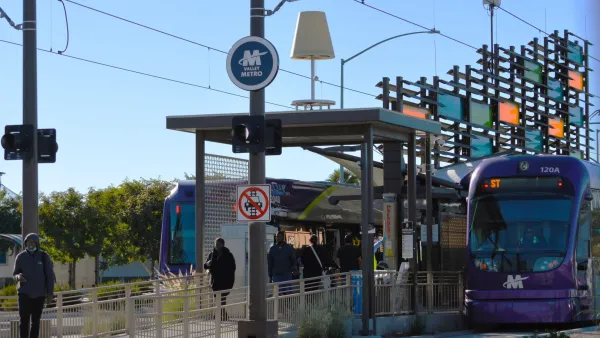
Phoenix Nixes Light Rail Plans, Shifts Focus to Expanding Transit in West Phoenix
The city is shelving plans for a proposed light rail expansion, opting instead to explore other alternatives for bringing rapid transit to West Phoenix.
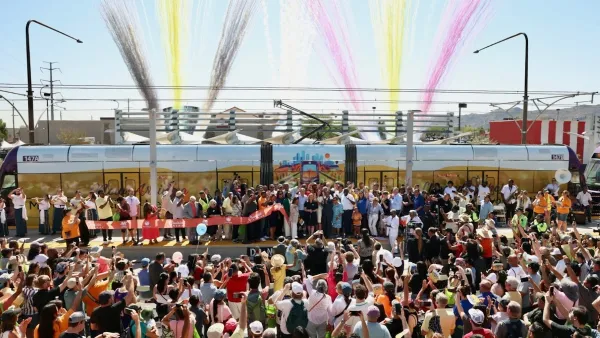
Phoenix Light Rail Extension Opens
The South Central line extends 5.5 miles of rail into South Phoenix neighborhoods, bringing the city’s total light rail network to 35 miles.

Phoenix Announces Opening Date for Light Rail Extension
The South Central extension will connect South Phoenix to downtown and other major hubs starting on June 7.

Planetizen Federal Action Tracker
A weekly monitor of how Trump’s orders and actions are impacting planners and planning in America.

‘Going backwards:’ Baltimore mayor, students rally against state's transit funding plan
Maryland's proposed six-year plan provides no funding for Baltimore’s BMORE bus program and reduces its road maintenance funding.

Detroit to transform waterfront with $2.2 billion investment
Developers will convert about 18 acres of unused parking lot space into civic spaces.

HUD, USDA agree on framework to simplify housing environmental review standards
Their agreement is a requirement of the 21st Century ROAD to Housing Act.

Cost of water rising at a faster pace than inflation, median household income
California and Maryland residents have seen their water bills grow especially high.

NYC building owners overwhelmingly comply with new emissions limits
The New York City Department of Buildings is fining owners who did not file emissions reports.

FREE Course: Walkable City 1: Why Walkability?
After describing his path towards focusing on walkability as the essence of good planning, Jeff Speck marches through his five principal reasons for making more walkable places.
Reinventing Malls: Planning Alchemy—Turning Gray Fields Into Gold
The course focuses on the opportunities and imperatives that shape reinvention of mall sites.

planning NEXT
City of Thousand Oaks
City of Wisconsin Rapids
The Architects Foundation
University of Cincinnati Online
Northern Illinois Transit Authority (NITA)
The Pocatello Development Authority
The Urban Renewal Agency of the City of Pocatello