Inside access to a huge volunteer effort underway in New York City to account for the condition of an estimated 600,000 street trees—where every single one of the city's trees counts.


"For the first time ever, the NYC Department of Parks and Recreation is working with thousands of volunteers to measure and map every single street tree on every single block in every single neighborhood in all five boroughs of the city," reports Philip Silva.
The article provides an in-depth look at the mechanics of the effort, dubbed TreesCount! 2015, which has ambitiously deployed 5,000 volunteers (so far) for "old fashioned site-surveying techniques." That means, according to SIlva: "No GPS. No Google Street View. No satellite imagery. Just a $90 measuring wheel, a plastic tape measure, and a meticulously designed data logging website filled to the brim with sophisticated geometry, cartography, and code."
The effort has already mapped 100,000 of the estimated 600,000 trees that call New York City home since it launched in May.
Also explained by Silva is the larger purpose of the census, namely: "NYC Parks, the department that oversees street trees in the Big Apple, wants to know what kinds of challenges each tree is facing and how much effort neighborhood volunteers are putting into keeping trees alive."
Read the full story: Mapping the Forest for the Trees: A Census Grows in the Five Boroughs
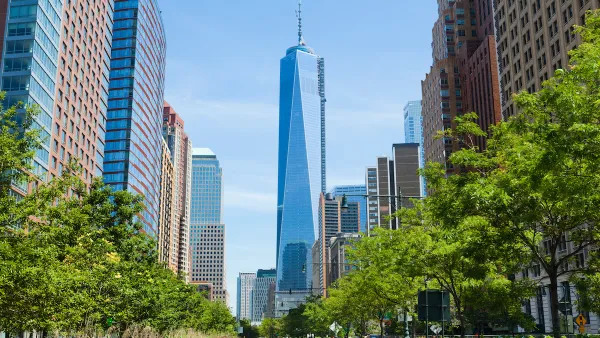
Tree Folio NYC Aims to Monitor Urban Forest in Real Time
A new tool could help the city reach its goal of planting up to 250,000 new trees by 2035.
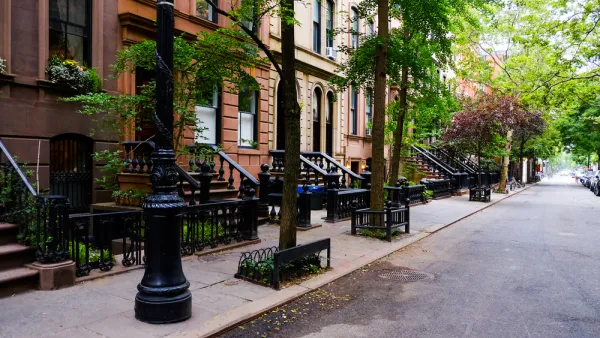
Looking to Add More Trees? Mind the 'Sidewalk Gray Zone'
A case study provided by the MillionTreesNYC program offers insight into complicated territorial boundaries that can challenge urban greening projects.

Invasive Beetles Put Oregon Forests at Risk
Two recently discovered borer beetles could lead to a significant loss of tree canopy.

Planetizen Federal Action Tracker
A weekly monitor of how Trump’s orders and actions are impacting planners and planning in America.

California plans to bury El Niño’s downpour
If the state plays its cards right, it may be able to store a billion acre-feet of El Niño’s water in aquifers.

Desperate measures: Advocates weigh draining Lake Powell to fill Colorado River
Draining the reservoir could reduce evaporation losses by a couple hundred thousand acre-feet.

Los Angeles just elected an urban planner as its mayor
Transportation analysts are optimistic that Raman will be more aggressive in addressing transit issues than Bass.

Mamdani’s pied-à-terre tax survives legal challenge
A panel of judges found that the plaintiffs failed to demonstrate injury as a result of New York City's implementation of the tax.

Eastern Nebraska is running out of electricity
Data centers and electrification are straining eastern Nebraska’s grid, throttling economic development.

FREE Course: Walkable City 1: Why Walkability?
After describing his path towards focusing on walkability as the essence of good planning, Jeff Speck marches through his five principal reasons for making more walkable places.
Reinventing Malls: Planning Alchemy—Turning Gray Fields Into Gold
The course focuses on the opportunities and imperatives that shape reinvention of mall sites.

City of Rosemead
Rutgers University, Edward J. Bloustein School of Planning and Public Policy
One Hundred Miles
University of Michigan School for Environment and Sustainability (SEAS)
Hunter College, City University of New York (CUNY)
The Architects Foundation
City of Cambridge
Montrose County
The Pocatello Development Authority