The National Oceanic and Atmospheric Administration has announced two new grant programs that focus on helping coastal communities and regions develop effective strategies to prepare for, and recover from, the effects of climate change.


"Two new NOAA grant programs will help coastal communities and their managers create on-the-ground projects to make them more resilient to the effects of extreme weather events, climate hazards, and changing ocean conditions," according to a NOAA press release.
"NOAA’s National Ocean Service is supporting the effort with $5 million in competitive grant awards through the 2015 Regional Coastal Resilience Grant Program and NOAA Fisheries is administering the companion $4 million Coastal Ecosystem Resiliency Grants Program."
The National Ocean Service 2015 Regional Coastal Resilience Grant Program, on the one hand, "will help coastal communities and organizations prepare for and recover from adverse events while adapting to changing environmental, economic, and social conditions" by planning and implementing regional resilience strategies.
The NOAA Fisheries’ Coastal Ecosystem Resiliency Grants Program "will focus on developing healthy and sustainable coastal ecosystems through habitat restoration and conservation" by demonstrating examples of the socioeconomic benefits achieved by the restoration of resilient and healthy coastal ecosystems.
Read the full story: NOAA announces $9 million in grants to improve coastal community resilience
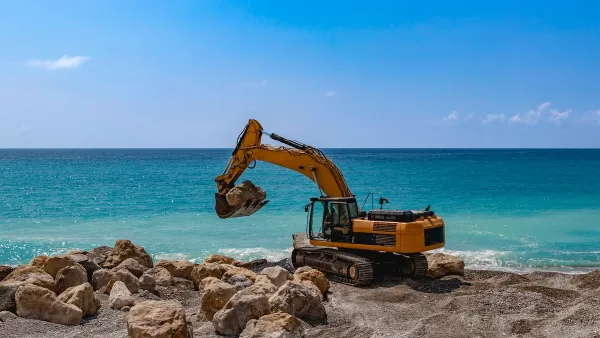
NOAA Awards $575M in Coastal Resilience Grants
The program received over $16 billion in requests from communities around the country.
'Digital Coast' Connects Planners and Data for Coastal Resilience
A new resource created by the National Oceanic and Atmospheric Administration in partnership with the APA makes it easier for planners to access the data necessary to plan for climate adaptation, sea level rise, and other forms of coastal resilience.
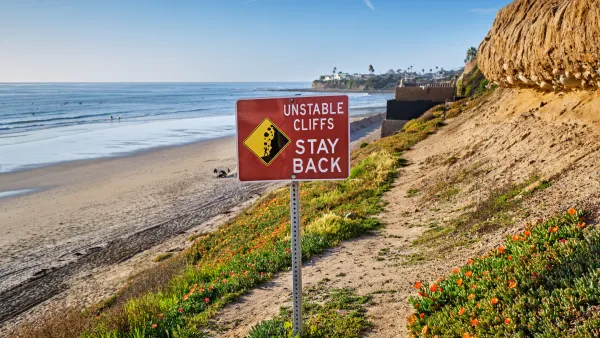
Coastal Climate Resilience to Receive $2.6 Billion Federal Investment
The Biden Administration announced the second massive investment of federal funds for coastal resilience on June 6. The Inflation Reduction Act allocated $3.3 billion to NOAA. In March, the Infrastructure Investment & Jobs Act added $562 billion.

Planetizen Federal Action Tracker
A weekly monitor of how Trump’s orders and actions are impacting planners and planning in America.

Eastern Nebraska is running out of electricity
Data centers and electrification are straining eastern Nebraska’s grid, throttling economic development.

Study reveals best places in the U.S. for cycling, walking
New research from Streetlight Data examines bicycle and pedestrian miles per capita in the 100 largest U.S. cities by population.

DSA members accuse Mamdani of 'abandoning values' over housing redevelopment
New York City's mayor plans to replace about 2,000 units of public housing with private, mixed-income housing.

All sides of BRT debate unhappy with CDOT’s most recent move
The Colorado Department of Transportation is no longer considering center-running bus lanes for Colorado Boulevard.

Massachusetts bogs generate both power, and cranberries
Putting solar panels above farmland is one way Massachusetts is advancing toward its goal of net-zero carbon emissions by 2050.

FREE Course: Walkable City 1: Why Walkability?
After describing his path towards focusing on walkability as the essence of good planning, Jeff Speck marches through his five principal reasons for making more walkable places.
Reinventing Malls: Planning Alchemy—Turning Gray Fields Into Gold
The course focuses on the opportunities and imperatives that shape reinvention of mall sites.

City of Rosemead
Rutgers University, Edward J. Bloustein School of Planning and Public Policy
One Hundred Miles
University of Michigan School for Environment and Sustainability (SEAS)
Hunter College, City University of New York (CUNY)
The Architects Foundation
City of Cambridge
The Pocatello Development Authority
The Urban Renewal Agency of the City of Pocatello