With snowpack down to 16 percent of normal levels, Washington officials are bracing for drought.


"Washington Gov. Jay Inslee declared a statewide drought Friday — citing historically low snowpack, dwindling rivers and rising temperatures that have plunged nearly the entire West Coast into official emergency status," reports Maria L. La Ganga.
La Ganga notes the peculiarity of this drought, which could dramatic have dramatic effects even as rain continues to fall on Pacific Northwest, as is typical of the region: "This is a snowpack drought, not a rain drought, and it's expected to hit rural Washington hardest. The state Department of Agriculture predicts $1.2 billion in crop losses. Wildlife officials are scrambling to figure out how to save the salmon. Firefighters are poised for disaster."
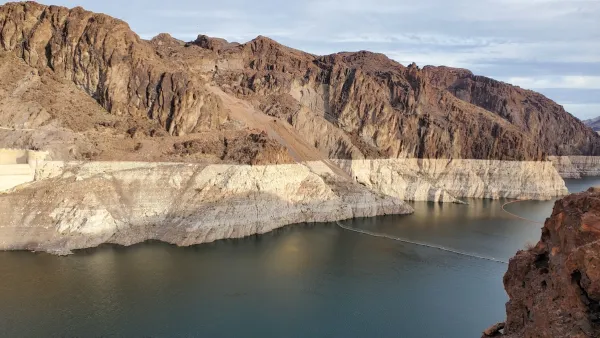
The news from Washington follows a, April drought emergency announcement in Oregon, encompassing two-thirds of the state, by Governor Kate Brown. Lake Mead, on the border of Arizona and Nevada, also made news in April, when it's water level set a record low.
Read the full story: Drought urgency hits rain country: Washington governor declares state emergency

Desperate measures: Advocates weigh draining Lake Powell to fill Colorado River
Draining the reservoir could reduce evaporation losses by a couple hundred thousand acre-feet.

California plans to bury El Niño’s downpour
If the state plays its cards right, it may be able to store a billion acre-feet of El Niño’s water in aquifers.
‘No state has sacrificed more:’ Arizona joins Nevada, sues feds over Colorado River plan
The Arizona Department of Water Resources' motion claims that the state's cities, tribes and farmers can't survive without sufficient water from the Colorado River.

Planetizen Federal Action Tracker
A weekly monitor of how Trump’s orders and actions are impacting planners and planning in America.
California plans to bury El Niño’s downpour
If the state plays its cards right, it may be able to store a billion acre-feet of El Niño’s water in aquifers.
Desperate measures: Advocates weigh draining Lake Powell to fill Colorado River
Draining the reservoir could reduce evaporation losses by a couple hundred thousand acre-feet.

Housing is the top priority of Seattle’s sole new councilmember
Jenks campaigned on building 1,000 new units of affordable housing.

New tax cuts may slash $1.5 billion in funding for Miami transit, public parks
Amendment 3 will save Miami-Dade residents homeowners $2,700 in 2028.

Arizona, Wisconsin, Pennsylvania hope to finally advance climate goals post-midterms
The three states have spent years under Republican or divided control.

FREE Course: Walkable City 1: Why Walkability?
After describing his path towards focusing on walkability as the essence of good planning, Jeff Speck marches through his five principal reasons for making more walkable places.
Reinventing Malls: Planning Alchemy—Turning Gray Fields Into Gold
The course focuses on the opportunities and imperatives that shape reinvention of mall sites.

City of Rosemead
Rutgers University, Edward J. Bloustein School of Planning and Public Policy
One Hundred Miles
University of Michigan School for Environment and Sustainability (SEAS)
Hunter College, City University of New York (CUNY)
The Architects Foundation
City of Cambridge
Montrose County
The Pocatello Development Authority