The 3D scan provided a safe and quick solution for potential restoration, rehabilitation, and preservation by capturing thousands of points a second and creates a virtual photograph of the object that it scans.


3D Virtual Technology to the Rescue
"Within a few days of the [August 24, 2014 South Napa] earthquake the founder of a local 3D imaging company, Shari Kamimori, offered her company’s services to help save the city’s threatened heritage. While the immediate post-disaster recovery and the work from the field team played a vital role in saving damaged structures, the use of 3D laser scanning offered the best hope for capturing buildings that were at risk for demolition. The scanning also served as a valuable preservation tool for buildings proposed for deconstruction, which is the careful dismantling and storing of a building for a later use. The 3D scan provided a safe and quick solution for potential restoration, rehabilitation, and preservation by capturing thousands of points a second and creates a virtual photograph of the object that it scans. This superhero technology quickly became the designer tool in Napa after earthquake during a time of when some were reacting quickly with the call for demolition."
Read the full story: Saving Napa’s Earthquake-Damaged Buildings with 3D Laser Scanning
When it Comes to Seismic Safety, It's Each City for Itself
Buildings constructed of unreinforced masonry get much if not most of the media's attention on seismic safety, but so-called 'soft story' wood buildings, often with garages on the ground floor, compose the greatest numbers of vulnerable buildings.
Napa Earthquake Shows Urgency of Building Retrofits
Sunday's powerful Bay Area earthquake brought attention to the urgent need to retrofit existing buildings in California. One expert stated the damage in Napa "was predictable." Do you know the three types of construction that need to be reinforced?
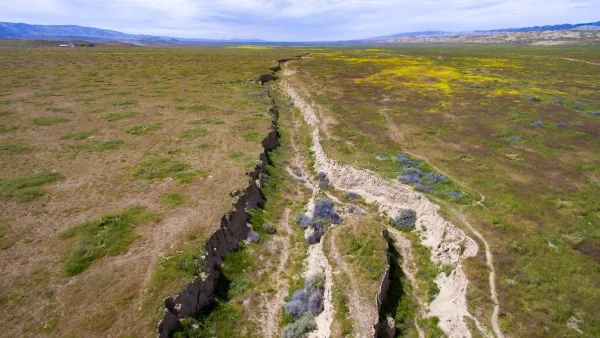
San Andreas fault at highest stress level in a millennium
A new study shows that the West Coast's major fault system is in 'a critically loaded state.'

Planetizen Federal Action Tracker
A weekly monitor of how Trump’s orders and actions are impacting planners and planning in America.

Eastern Nebraska is running out of electricity
Data centers and electrification are straining eastern Nebraska’s grid, throttling economic development.
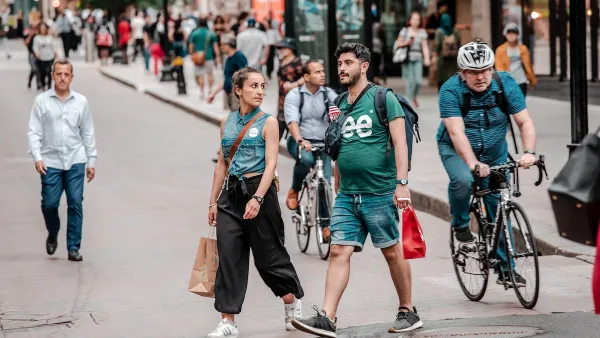
Study reveals best places in the U.S. for cycling, walking
New research from Streetlight Data examines bicycle and pedestrian miles per capita in the 100 largest U.S. cities by population.

DSA members accuse Mamdani of 'abandoning values' over housing redevelopment
New York City's mayor plans to replace about 2,000 units of public housing with private, mixed-income housing.

All sides of BRT debate unhappy with CDOT’s most recent move
The Colorado Department of Transportation is no longer considering center-running bus lanes for Colorado Boulevard.

Massachusetts bogs generate both power, and cranberries
Putting solar panels above farmland is one way Massachusetts is advancing toward its goal of net-zero carbon emissions by 2050.

FREE Course: Walkable City 1: Why Walkability?
After describing his path towards focusing on walkability as the essence of good planning, Jeff Speck marches through his five principal reasons for making more walkable places.
Reinventing Malls: Planning Alchemy—Turning Gray Fields Into Gold
The course focuses on the opportunities and imperatives that shape reinvention of mall sites.

City of Rosemead
Rutgers University, Edward J. Bloustein School of Planning and Public Policy
One Hundred Miles
University of Michigan School for Environment and Sustainability (SEAS)
Hunter College, City University of New York (CUNY)
The Architects Foundation
City of Cambridge
The Pocatello Development Authority
The Urban Renewal Agency of the City of Pocatello