The six proposed WTC design lack an understanding of the site's importance. A Flash gallery allows comparisons of the designs.


"But ultimately, the designs reveal how fixed many of the initial planning decisions seem to be. In each, significant portions of the street grid that was removed in the 1970s would be rebuilt, dividing the 16-acre site into smaller parcels. Part of West Street would be replaced by an underground tunnel to connect the site to nearby Battery Park City. About 11 million square feet of commercial office space and 600,000 square feet of retail space would be replaced. And all of the plans include a museum and one or two cultural venues. Most of these ideas were formulated within months of the September attacks.What the proposals lack is any sense of the site's importance as a monumental expression of one of the most tragic events in the nation's history."
Thanks to Laura Kranz
Read the full story: Ideas for Ground Zero: Where's the Imagination?


Planetizen Federal Action Tracker
A weekly monitor of how Trump’s orders and actions are impacting planners and planning in America.

‘Going backwards:’ Baltimore mayor, students rally against state's transit funding plan
Maryland's proposed six-year plan provides no funding for Baltimore’s BMORE bus program and reduces its road maintenance funding.
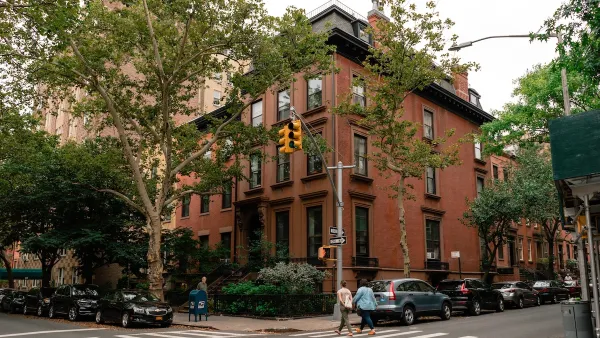
Mamdani sent nearly 6,000 pied-à-terre tax warnings to homes that didn’t qualify
A judge has ordered the administration to cancel thousands of pied-à-terre tax notices after it sent 35% of them erroneously.

Mamdani sent nearly 6,000 pied-à-terre tax warnings to homes that didn’t qualify
A judge has ordered the administration to cancel thousands of pied-à-terre tax notices after it sent 35% of them erroneously.

Detroit to transform waterfront with $2.2 billion investment
Developers will convert about 18 acres of unused parking lot space into civic spaces.

‘Going backwards:’ Baltimore mayor, students rally against state's transit funding plan
Maryland's proposed six-year plan provides no funding for Baltimore’s BMORE bus program and reduces its road maintenance funding.

FREE Course: Walkable City 1: Why Walkability?
After describing his path towards focusing on walkability as the essence of good planning, Jeff Speck marches through his five principal reasons for making more walkable places.
Reinventing Malls: Planning Alchemy—Turning Gray Fields Into Gold
The course focuses on the opportunities and imperatives that shape reinvention of mall sites.

City of Thousand Oaks
City of Wisconsin Rapids
Harvard University Graduate School of Design
The Architects Foundation
University of Cincinnati Online
Northern Illinois Transit Authority (NITA)
The Pocatello Development Authority
The Urban Renewal Agency of the City of Pocatello