The future of Dallas is very much under consideration. Case in point: an effort to redesign and plan the 277 acres of Fair Park with the potential to offer improved public access to a critical area east of Downtown.


Robert Wilonsky provides an update on developing plans for the renovation of Fair Park in Dallas, home to the Dallas State Fair, among other events.
"It has been more than a year since we were formally introduced to Mayor Mike Rawlings’ secret-at-the-time Fair Park Task Force, and seven months since the group unveiled its proposal [pdf] and recommended, among other things, turning over Fair Park’s 277 acres to a private, nonprofit operating-marketing 'authority'….The city’s Park Board continues to discuss the task force’s recommendations."
But a new wrinkle to the planning and design effort was added recently, when a second, smaller group proposed "an even more radical redo" of the park. That plan, by Boston-based architect and urban designer Antonio Di Mambro, "essentially divvies up the park into four sections, moves the State Fair of Texas to a 93-acre section of Fair Park, proposes tearing down the Gexa Energy Pavilion and eliminating a section of the Cotton Bowl, and envisions turning the Art Deco buildings into an 'educational complex/innovation district' or mixed-use 'retail marketplace,'" according to Wilonsky.
Wilonsky provides more details of the plan and introduces some of the political support behind the concept. For instance, a "Fair Park makeover is actually a key plank in the platform of the Coalition for a New Dallas PAC, which is calling for the removal of Interstate 345 between downtown and Deep Ellum."
Read the full story: Proposal calls for a radical redo of Fair Park — and the State Fair of Texas’ place in it

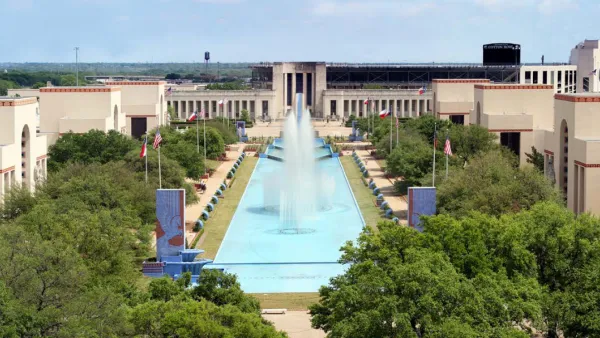
New Park Coming to Historic Dallas Fairgrounds
A 20-year plan to revitalize a historic Dallas fairground will bring much-needed new green space and multi-use venues to Fair Park.
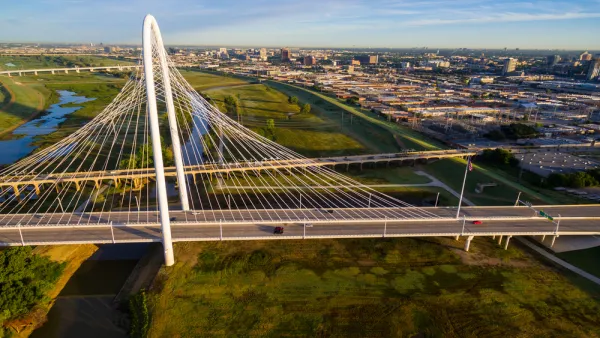
First Look at the Planned Trinity Park in Dallas
Dreams look a lot more like reality this week in Dallas.
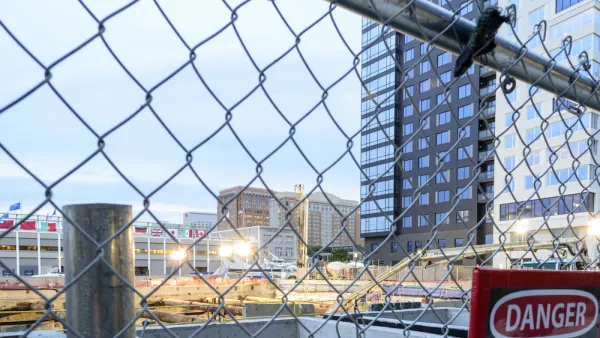
Development Overtakes Open Space in Boston's Seaport District
Planners worry that the success of the waterfront district has led to its overdevelopment.

Planetizen Federal Action Tracker
A weekly monitor of how Trump’s orders and actions are impacting planners and planning in America.

Amtrak, CN end decades-long dispute with eight-year agreement
The new operating agreement establishes an updated framework for the companies to work together, including processes to resolve disputes.

Northwest rail fans eager for Sept. 30 debut of Amtrak’s Airo fleet
Get ready for that new train smell and more seats. But they won’t go faster or run more frequently on the Cascades route in Washington and Oregon.

Brightline Florida files for bankruptcy
The transit company is over $5 billion in debt.

St. Louis Metro to test if single-car trains can reduce operating costs, maintain rider satisfaction
The pilot program will run from October to spring 2027, and begin with one single-car train operating on Metrolink’s Red and Blue lines.

Pennsylvania is building data centers in abandoned mines
Housing data centers in mines provides an alternative to destroying local forests and may spare residents from data centers’ noise and air pollution.

FREE Course: Walkable City 1: Why Walkability?
After describing his path towards focusing on walkability as the essence of good planning, Jeff Speck marches through his five principal reasons for making more walkable places.
Reinventing Malls: Planning Alchemy—Turning Gray Fields Into Gold
The course focuses on the opportunities and imperatives that shape reinvention of mall sites.

City of Thousand Oaks
City of Wisconsin Rapids
Harvard University Graduate School of Design
The Architects Foundation
University of Cincinnati Online
The Pocatello Development Authority
The Urban Renewal Agency of the City of Pocatello