A massive bike park in Louisville, Kentucky takes the fast-growing trend of urban bike parks to new (subterranean) levels.


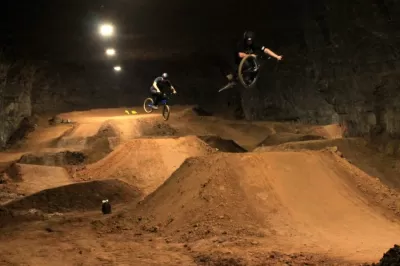
Kim Cross reports: "Seventy-five feet under the Louisville Zoo, in a labyrinth of Kentucky limestone mined into Swiss cheese, a few million pounds of soil have been sculpted into the trails, berms, and jumps at Mega Cavern, the world’s first underground bike park. When it opens to the public in February, the park will have more than five miles of interconnected trails that range from flowing singletrack to dirt jumps to technical lines with three-foot drops. And that’s just the first of three phases to roll out this winter."
According to the article, Mega Cavern is only the latest example of a trend that began beneath an elevated portion of the I-5 freeway in Seattle at a park known as the Colonnade. In fact, "[there] are now some 100 urban bike parks across the country, everywhere from Boulder, Colorado, to Chicago. And the most recent trend is to move them indoors."
The article includes an interview with Mega Cavern designer Joe Prisel, "one of the country’s most sought-after bike-park builders and architects."
Read the full story: Mountain Biking Takes It Inside


Learning loss and urban schools, part 2
Did test scores in progressive cities drop more post-COVID than test scores in moderate ones?
3DUnderground Project Maps NYC’s Subterranean Infrastructure
A new digital platform is aimed at helping agencies better understand the city’s underground assets and more effectively plan projects.
Louisville Creates its First Municipal DOT
The new department will be tasked with speeding up transportation and infrastructure projects.

Planetizen Federal Action Tracker
A weekly monitor of how Trump’s orders and actions are impacting planners and planning in America.

Chicago breaks ground on $3 billion megadevelopment
The new neighborhood, titled Foundry Park, will one day host 3,700 residences.

This MA town is drowning in its own sewage — and residents like it that way
Susan Murcott, a waste water expert, said if Carlisle didn't address their leaking sewage, the problem could turn “deadly.”

Iowa taxpayers are paying thousands to clean manure out of their water
While the Clean Water Act makes states responsible for regulating factory farms that discharge pollutants, Iowa has turned a blind eye to the polluting farms.

Amtrak cuts ribbon on Seattle Airo maintenance facility
The $250 million, nearly 100,000-square-foot building can house an entire Cascades Airo trainset.

To power data centers, Google seeks autonomous control of thousands of homes’ electricity
The tech company has signed a deal to indirectly pay Mid-Atlantic residents to reduce their power demand when the grid is strained.

FREE Course: Walkable City 1: Why Walkability?
After describing his path towards focusing on walkability as the essence of good planning, Jeff Speck marches through his five principal reasons for making more walkable places.
Reinventing Malls: Planning Alchemy—Turning Gray Fields Into Gold
The course focuses on the opportunities and imperatives that shape reinvention of mall sites.

City of Rosemead
Rutgers University, Edward J. Bloustein School of Planning and Public Policy
One Hundred Miles
The Architects Foundation
University of Cincinnati Online
Montrose County
The Pocatello Development Authority
The Urban Renewal Agency of the City of Pocatello