In an attempt to fix Los Angeles' buckling streets and roads, the Los Angeles City Council has unveiled a proposal allowing residents to tax themselves for adjacent road and sidewalk repair.


As reported in the Los Angeles Times, Laura Nelson discusses Councilman Joe Buscaino's new "beautification assessment districts" proposal, to allow residents to tax themselves for city infrastructure repairs. Nearly 40 percent of Los Angeles' streets are given the lowest grade of street condition, D or F. This figure represents about 8,200 lane miles within the city that are in dire need of maintenance, at an estimated $1.5 billion.
The beautification assessment district proposal was one of eight introduced to the City Council on Wednesday, aiming to improve the crumbling state of Los Angeles' infrastructure. To enact this proposal, "districts would have to be approved through a neighborhood election. Fees for tree-trimming, road paving and sidewalk repair could be added to property owners' annual tax bill. Property owners who already pay for street light installation and maintenance might be able to vote to simply broaden the tax to cover those costs."
The beautification assessment district proposal follows on the heels of an abandoned sales tax measure retracted from the November ballot, which would have raised about $4.5 billion to repair Los Angeles' worst roads and sidewalks.
Read the full story: Angelenos could tax themselves to fix roads under City Hall proposal
Sidewalk Busted? Fix it Yourself
The city of Los Angeles is considering a plan to stop paying for repairs to broken sidewalks and driveways, shifting the economic burden to property owners.
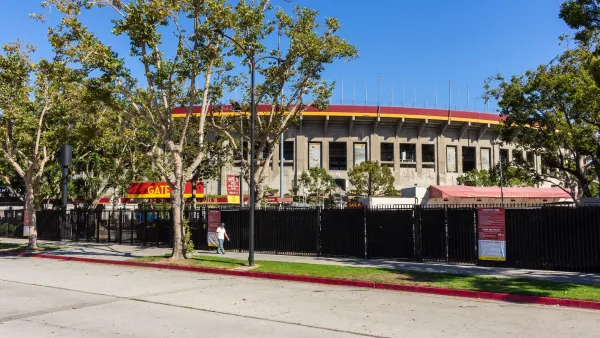
LA authorizes $9.5M for sidewalk repairs around Olympic venues
The city is hosting the Olympic and Paralympic Games in 2028.
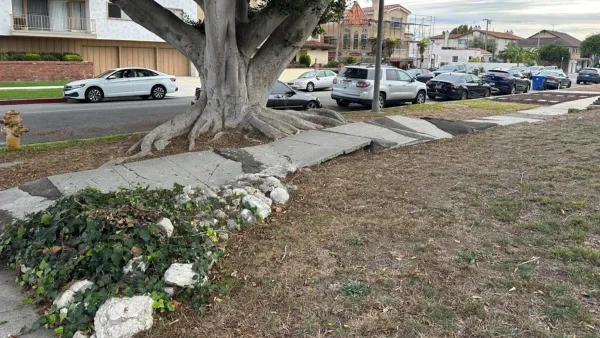
The City of Broken Sidewalks
Can Los Angeles fix 4,000 miles of broken sidewalks before the city hosts the 2028 Olympic Games?

Planetizen Federal Action Tracker
A weekly monitor of how Trump’s orders and actions are impacting planners and planning in America.

Washington state to charge fee to drivers with fuel-efficient cars
Revenue from the fee will go towards supporting the state’s highways.

Trump to blast ‘hydrocarbon highway’ through ‘world’s longest art gallery’
Environmental and historic preservation groups are suing to stop the project.

MBTA Green Line project moved to next phrase of CIG program
The modernization effort will cost $4.08 billion.

22-mile pedestrian and bike path to encircle Atlanta by 2030
The project will also support affordable housing.

Army detonates nearly 5 tons of lead in Iowa
The detonation comes after days of delays and public outcry.

FREE Course: Walkable City 1: Why Walkability?
After describing his path towards focusing on walkability as the essence of good planning, Jeff Speck marches through his five principal reasons for making more walkable places.
Reinventing Malls: Planning Alchemy—Turning Gray Fields Into Gold
The course focuses on the opportunities and imperatives that shape reinvention of mall sites.

City of Charlotte
City of Rosemead
Rutgers University, Edward J. Bloustein School of Planning and Public Policy
University of Michigan School for Environment and Sustainability (SEAS)
Hunter College, City University of New York (CUNY)
The Architects Foundation
University District Partnership