The old Civic Arena site, formerly the home of the Pittsburgh Penguin NHL team, will be redeveloped with the help of the city's largest-ever tax increment financing district.


"Local political leaders and the Pittsburgh Penguins have cleared the way for the redevelopment of the former Civic Arena site with a wide-ranging deal that creates the largest tax diversion district in the city’s history while giving the team more time to get started," reports Mark Belko.
The redevelopment of the site will attempt to undo the urban renewal project that birthed the Civic Arena. "Mayor Bill Peduto said the deal not only would ensure the redevelopment of the arena site in the lower Hill but would help to 'mend and heal' the neighborhood, which was separated from Downtown and saw 1,300 buildings leveled in an early 1960s urban renewal plan built around the Civic Arena construction."
As for the TIF deal that will drive the redevelopment of the area: "At the center of the agreement is a tax increment financing plan that will generate at least $22 million — some estimates are as high as $50 million — over 20 years for redevelopment activities in the Hill and adjacent Uptown." Moreover, "[under] the TIF, 65 percent of the new tax revenue produced by the project will be used for improvements. The other 35 percent will go to the city, county and city school district."
Read the full story: Penguins, Pittsburgh reach agreement on redeveloping former Civic Arena site
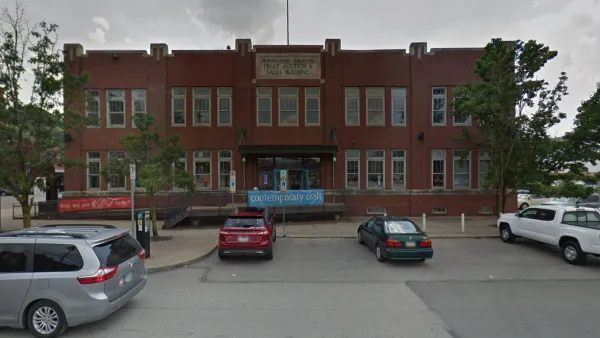
Tax Increment Financing a Possibility for Big Pittsburgh Redevelopment Project
A $125 million adaptive reuse project is looking for help with infrastructure improvements. Pittsburgh's Urban Redevelopment Authority is considering tax increment financing to fund street improvements.
Revealed: A Splashy New Master Plan for Former Civic Arena Site in Pittsburgh
One of the country's most beautiful cities could get a dramatic new development project, calling on the design talents of Bjarke Ingels Group.
More Colorado Cities Resisting Urban Renewal Authority
The Denver Post reports on a growing backlash against urban renewal authority in Colorado.

Planetizen Federal Action Tracker
A weekly monitor of how Trump’s orders and actions are impacting planners and planning in America.

California plans to bury El Niño’s downpour
If the state plays its cards right, it may be able to store a billion acre-feet of El Niño’s water in aquifers.

Desperate measures: Advocates weigh draining Lake Powell to fill Colorado River
Draining the reservoir could reduce evaporation losses by a couple hundred thousand acre-feet.

Los Angeles just elected an urban planner as its mayor
Transportation analysts are optimistic that Raman will be more aggressive in addressing transit issues than Bass.

Mamdani’s pied-à-terre tax survives legal challenge
A panel of judges found that the plaintiffs failed to demonstrate injury as a result of New York City's implementation of the tax.

Eastern Nebraska is running out of electricity
Data centers and electrification are straining eastern Nebraska’s grid, throttling economic development.

FREE Course: Walkable City 1: Why Walkability?
After describing his path towards focusing on walkability as the essence of good planning, Jeff Speck marches through his five principal reasons for making more walkable places.
Reinventing Malls: Planning Alchemy—Turning Gray Fields Into Gold
The course focuses on the opportunities and imperatives that shape reinvention of mall sites.

City of Rosemead
Rutgers University, Edward J. Bloustein School of Planning and Public Policy
One Hundred Miles
University of Michigan School for Environment and Sustainability (SEAS)
Hunter College, City University of New York (CUNY)
The Architects Foundation
City of Cambridge
Montrose County
The Pocatello Development Authority