The residents of Camden County in New Jersey, across the Delaware River from Philadelphia, banded together to catalog the abandoned properties in their neighborhoods, where the problem of abandoned, or "zombie" properties, is growing.


Several Camden County communities - Collingswood, Audubon, Haddonfield, Haddon Township, Oaklyn, Pennsauken, and the Fairview section of Camden - have joined forces, enlisting the help of two doctoral candidates and a master's student from Rutgers-Camden's department of public policy and administration to identify the abandoned or derelict vacant properties in their midst," reports Rita Giordano.
"The hope is that the coalition will be able to convince banks that may have gotten the houses through foreclosure that it is worthwhile to sell them. At the least, it wants the banks and mortgage companies to do a better job of maintenance."
Read the full story: N.J. municipalities join forces to deal with vacant homes

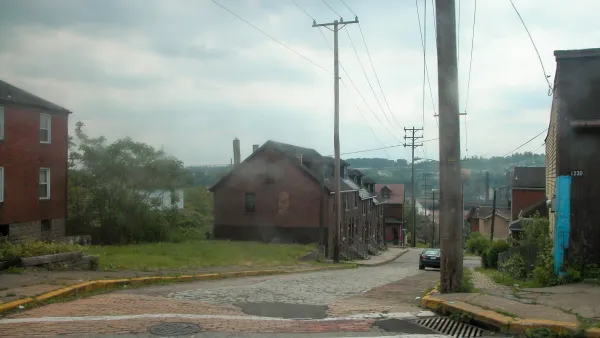
Managing Abandoned Homes in North Braddock
The usual litany of Rust Belt woes hit North Braddock, Pennsylvania particularly hard. The Pittsburgh suburb has shed two-thirds of its population and is burdened with 350 abandoned properties.
Ohio Makes it Easier to Fight Blight
Ohio has been one of the hardest hit states by the recent wave of foreclosures, with filings continuing to rise. Susie Cagle looks at the variety of state and local policies and programs arming communities with new tools to fight blight.

Japan Offers Up Free Abandoned Houses
Due to an aging populace, lackluster construction quality, and other factors, Japan is facing a glut of abandoned homes. For those with the ability to live there, these homes can be had for next to nothing.

Planetizen Federal Action Tracker
A weekly monitor of how Trump’s orders and actions are impacting planners and planning in America.

Amtrak, CN end decades-long dispute with eight-year agreement
The new operating agreement establishes an updated framework for the companies to work together, including processes to resolve disputes.

Judges permit Denver to divert 77,000 acre feet from the Colorado River for reservoir expansion
Overuse and climate change have caused the Colorado River’s water levels to plummet.

NYC DOT wants faster, more permanent street upgrades
The city is examining ways to build more concrete infrastructure without getting entangled in 'decades-long' projects.

'Something we’ve never seen before:' rising utility rates could strain city finances nationwide
Data centers, climate change and other factors have caused utility rates in the United States to increase by 38% since 2020.

Trump to overrule local leaders, lease millions of acres of America’s Pacific Island territories’ seafloors to mining companies
International law says that the Indigenous people of America’s territories have a right to prior and informed consent regarding projects that impact their countries.

FREE Course: Walkable City 1: Why Walkability?
After describing his path towards focusing on walkability as the essence of good planning, Jeff Speck marches through his five principal reasons for making more walkable places.
Reinventing Malls: Planning Alchemy—Turning Gray Fields Into Gold
The course focuses on the opportunities and imperatives that shape reinvention of mall sites.

Harvard University Graduate School of Design
KFH Group Inc.
Greater Baltimore Committee
The Architects Foundation
University of Cincinnati Online
The Pocatello Development Authority
The Urban Renewal Agency of the City of Pocatello