Angie Schmitt covers Bike Portland's article on store owners teaming up to bring road diet as a means to improve business.


Michael Andersen's blogs for Bike Portland about business owners who are teaming up to bring a protected bike lane to their streets along 2nd and 3rd Avenues of Downtown Portland. Per Andersen, the business owners see the bike lanes "as a way to make the neighborhood safer, more comfortable and better to do business in."
According to Andersen, the team is "[inspired] by nearby projects on SW Ankeny and NE Multnomah," and are seeking the protected bike lane solution versus the current closed-to-traffic weekends enforced with "heavy police presence, the frequent need to tow cars from the area and the difficulty of navigating the barricades." Operating as the Old Town Hospitality Group, the business owners are in the process of designing concept plans for the quarter-mile stretch of road diets.
Read the full story: Seeing business upsides, Old Town retailers propose protected bike lanes on 2nd, 3rd
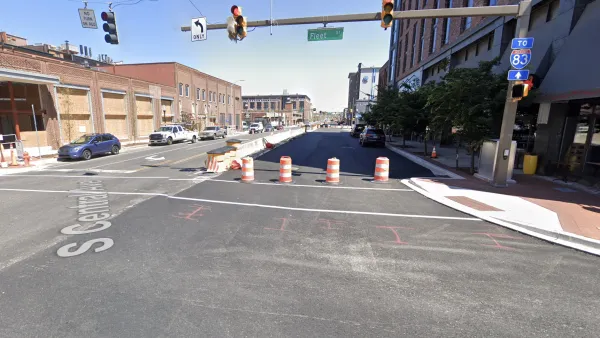
Protected Bike Lanes, Vehicle Lane Reductions Cause Stir in Baltimore
Residents and business operators say they weren’t warned about a road diet planned for a major thoroughfare in Baltimore. Planners and advocates say the changes have been a long time coming.
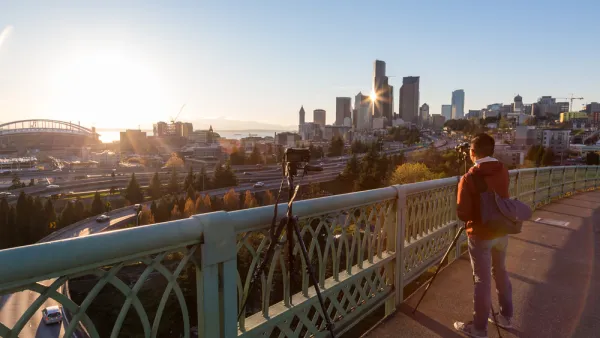
A Thorough, Mixed Review for a New Protected Bike Lane in Seattle
So many highly anticipated bike facilities finally deliver only to fall short of real game changing status. Seattle provides the latest example of the phenomenon in the wild.
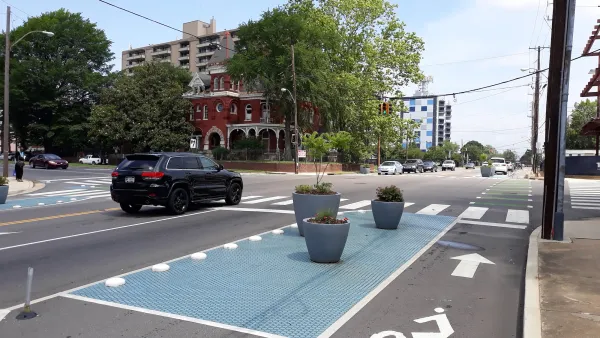
Memphis Street Goes on a Road Diet
Separated bike lanes and new pedestrian infrastructure have replaced traffic lanes on a mile of Manassas Street in Memphis.

Desperate measures: Advocates weigh draining Lake Powell to fill Colorado River
Draining the reservoir could reduce evaporation losses by a couple hundred thousand acre-feet.

Eastern Nebraska is running out of electricity
Data centers and electrification are straining eastern Nebraska’s grid, throttling economic development.

Move over, LA: St. Louis gears up for Olympics, invests millions in downtown redevelopment
The Missouri city will host the 2028 Olympic soccer group stage and knockout matches.

Maryland’s $15 billion bridge project gains key approval
The Maryland Transit Authority said the project will create over 60,000 jobs and add $23 billion to the local economy.

‘No clear next steps’ for Chicago's permanent festival grounds
Eleventh Ward Ald. Nicole Lee has suggested Soldier Field as a possible location for the permanent event space.

California, Hawaii, Rhode Island approve housing propositions
Hawaii and Rhode Island each approved their sole proposition, while California approved two of its three.

FREE Course: Walkable City 1: Why Walkability?
After describing his path towards focusing on walkability as the essence of good planning, Jeff Speck marches through his five principal reasons for making more walkable places.
Reinventing Malls: Planning Alchemy—Turning Gray Fields Into Gold
The course focuses on the opportunities and imperatives that shape reinvention of mall sites.

City of Rosemead
Rutgers University, Edward J. Bloustein School of Planning and Public Policy
One Hundred Miles
University of Michigan School for Environment and Sustainability (SEAS)
Hunter College, City University of New York (CUNY)
The Architects Foundation
City of Cambridge
Montrose County
The Pocatello Development Authority