According to Kyle Chayka's critique of "The Rise of Innovation Districts" report by the Brookings Institutions, "all is not right in this innovation ideology."


In fact, says Chayka, the innovation economy looks a lot like gentrification:
"While innovation districts may catalyze growth, it remains to be seen how sustainable that growth will be. In the world of entrepreneurial technology, ephemerality and competition are king: The losers are quickly weeded out and the winners go on to be absorbed into larger winners. The process only benefits a thin spectrum of the population that already has access to the kinds of capital—education, real estate, connections—that the innovation economy thrives on. The rest, it leaves behind."
Chayka also argues that the report does not go far enough in suggesting strategies for innovation districts to promote inclusive growth. "Any city looking at developing an innovation district as a way to seek economic growth must ensure that it is sustainable, organic, and woven into the pre-existing fabric rather than simply plopped onto an empty-looking post-industrial neighborhood."
Read the full story: Does Innovation Always Lead to Gentrification?
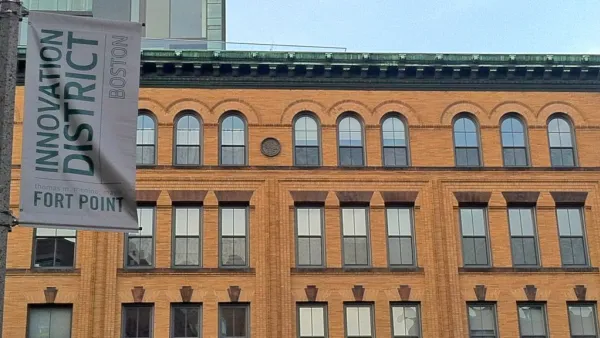
Status Report: the Rise of Innovation Districts
Last year, the "innovation district" rose to prominence as a way to describe urban knowledge economy epicenters. This report from Bruce Katz and Brookings describes how the phenomenon continues to evolve.
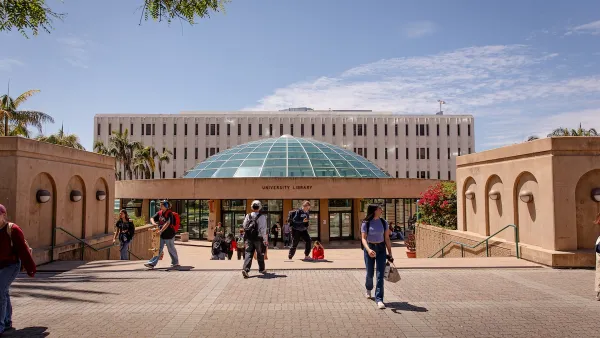
Elections come and go. Universities stay
University-led innovation districts give cities growth that outlasts political cycles.

How ‘post-disaster gentrification’ alters neighborhoods after natural calamities
After hurricanes, fires or other calamities, the original residents of a community are often replaced by younger, wealthier residents.

Planetizen Federal Action Tracker
A weekly monitor of how Trump’s orders and actions are impacting planners and planning in America.

Eastern Nebraska is running out of electricity
Data centers and electrification are straining eastern Nebraska’s grid, throttling economic development.

Study reveals best places in the U.S. for cycling, walking
New research from Streetlight Data examines bicycle and pedestrian miles per capita in the 100 largest U.S. cities by population.

DSA members accuse Mamdani of 'abandoning values' over housing redevelopment
New York City's mayor plans to replace about 2,000 units of public housing with private, mixed-income housing.

All sides of BRT debate unhappy with CDOT’s most recent move
The Colorado Department of Transportation is no longer considering center-running bus lanes for Colorado Boulevard.

Massachusetts bogs generate both power, and cranberries
Putting solar panels above farmland is one way Massachusetts is advancing toward its goal of net-zero carbon emissions by 2050.

FREE Course: Walkable City 1: Why Walkability?
After describing his path towards focusing on walkability as the essence of good planning, Jeff Speck marches through his five principal reasons for making more walkable places.
Reinventing Malls: Planning Alchemy—Turning Gray Fields Into Gold
The course focuses on the opportunities and imperatives that shape reinvention of mall sites.

City of Rosemead
Rutgers University, Edward J. Bloustein School of Planning and Public Policy
One Hundred Miles
University of Michigan School for Environment and Sustainability (SEAS)
Hunter College, City University of New York (CUNY)
The Architects Foundation
City of Cambridge
The Pocatello Development Authority
The Urban Renewal Agency of the City of Pocatello