The residents and government of the city of Nome, Alaska are unimpressed with the whining they heard this winter.


Nome, Alaska - The Office of Mayor Denise Michels released a statement earlier this week in response to claims that this winter was more difficult than normal in many parts of the United States.
Included in the statement: “Which Polar Vortex? Oh, that Polar Vortex? We call that Thursday.”
At a press conference to announce the statement, Mayor Michels asked reporters, “Did you hear what happened in Atlanta?” before slapping her forehead and exhaling pure disgust.
“I just want to offer you all some perspective,” said Mayor Michels. “Here in Nome, the average January temperature is 5.2 °F. That’s -14.9 °C for those of you living it up in Canada all winter long.”
Mayor Michels reminded the Lower 48 that although highs may breach the freezing point 2-4 times per month from December to March, Nome experiences 74-75 days a year when temperatures fall to 0 °F (-18 °C) or lower.
Michels concluded the press conference with an invitation: “If you think you can handle that, you’re welcome in Nome any time. We’ll grab a beer and watch the Seahawks game or something.”
Read the full story: Nome, Alaska to Lower 48: What Polar Vortex?

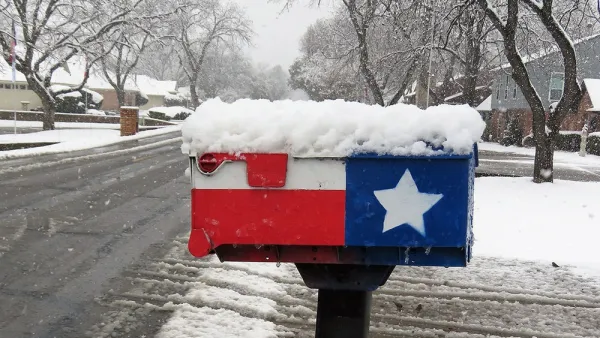
California-Style Rolling Blackouts Come to Texas
As bad as the power outages are in Texas, they would be much worse if the independent energy grid operator hadn't initiated rolling blackouts. In an extensive interview with CBS Austin, Bill Magness, the head of ERCOT, explains what went wrong.

Self-Driving Cars Still Can't Recognize the Difference Between a Wedding Planner and an Urban Planner
Pundits agree that planners need to prepare for self-driving cars. Self-driving cars still need to prepare for planners.
Florida Man Thought the New Comp Plan Included Zoning Changes
A Florida man is accused of not realizing an entirely separate process would be required to implement the zoning changes recommended in a recently approved comprehensive plan.

Planetizen Federal Action Tracker
A weekly monitor of how Trump’s orders and actions are impacting planners and planning in America.

Amtrak, CN end decades-long dispute with eight-year agreement
The new operating agreement establishes an updated framework for the companies to work together, including processes to resolve disputes.

Northwest rail fans eager for Sept. 30 debut of Amtrak’s Airo fleet
Get ready for that new train smell and more seats. But they won’t go faster or run more frequently on the Cascades route in Washington and Oregon.

Brightline Florida files for bankruptcy
The transit company is over $5 billion in debt.

St. Louis Metro to test if single-car trains can reduce operating costs, maintain rider satisfaction
The pilot program will run from October to spring 2027, and begin with one single-car train operating on Metrolink’s Red and Blue lines.

Pennsylvania is building data centers in abandoned mines
Housing data centers in mines provides an alternative to destroying local forests and may spare residents from data centers’ noise and air pollution.

FREE Course: Walkable City 1: Why Walkability?
After describing his path towards focusing on walkability as the essence of good planning, Jeff Speck marches through his five principal reasons for making more walkable places.
Reinventing Malls: Planning Alchemy—Turning Gray Fields Into Gold
The course focuses on the opportunities and imperatives that shape reinvention of mall sites.

City of Thousand Oaks
City of Wisconsin Rapids
Harvard University Graduate School of Design
The Architects Foundation
University of Cincinnati Online
The Pocatello Development Authority
The Urban Renewal Agency of the City of Pocatello