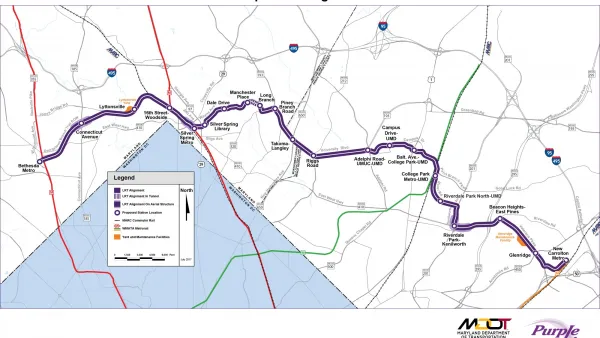
The Federal Transit Authority has granted one of the final approvals needed for the Purple Line—a 16-mile light rail line between Bethesda and New Carrollton in Maryland.


“The Federal Transit Administration has just issued a Record of Decision for the Purple Line, basically approving the 16-mile light rail line between Bethesda and New Carrollton,” reports Dan Reed. Maryland Transit Administration officials made the announcement during a Montgomery County Planning Board meeting. The FTA is expected to make a formal announcement next week.
“The agency's decision means Maryland can start purchasing right-of-way to build the $2.37 billion Purple Line, and makes it eligible for federal funding. President Obama recently included it in his 2015 budget, which Congress will have to approve later this year.” The Purple Line is scheduled to break ground next year and open in 2020.
Regarding the certainty of the Purple Line’s construction, Reed reports: “With state funding in place and an ongoing search for a private partner in the works, nearly all of the money needed has been secured. As a sign of how likely the Purple Line is to get built, the Planning Board is meeting today to make detailed recommendations about how it should interact with surrounding neighborhoods, like what materials to use for retaining walls.”
In a separate article, Robert McCartney details the last-gasp opposition efforts of the Town of Chevy Chase. McCartney sums up the situation thusly: “Some people have more money than good judgment.”
In a bit of dumb luck, Los Angeles has had a similar issue with a proposed transit line of the same name that will have to pass through Beverly Hills.
Read the full story: With federal approval in hand, the pieces needed to build the Purple Line fall into place

Maryland's Purple Line Gets the Green Light Again
The public-private partnership behind the Purple Line light rail project in Maryland fell apart in September, and has this past week been revived.
Purple Line Construction Halts in Maryland as Contractor Woes Deepen
Purple Line Transit Partners, the contractors managing construction of the beleaguered Purple Line in Maryland, have begun to walk off the job as a dispute about cost overruns brings the project to a screeching halt.
Preserving Affordable Housing Along Maryland Light Rail Line
A new plan lays out strategies to keep housing affordable for low- and moderate-income residents along the corridor of Maryland’s new Purple Line.

Planetizen Federal Action Tracker
A weekly monitor of how Trump’s orders and actions are impacting planners and planning in America.

Amtrak, CN end decades-long dispute with eight-year agreement
The new operating agreement establishes an updated framework for the companies to work together, including processes to resolve disputes.

Judges permit Denver to divert 77,000 acre feet from the Colorado River for reservoir expansion
Overuse and climate change have caused the Colorado River’s water levels to plummet.

NYC DOT wants faster, more permanent street upgrades
The city is examining ways to build more concrete infrastructure without getting entangled in 'decades-long' projects.

'Something we’ve never seen before:' rising utility rates could strain city finances nationwide
Data centers, climate change and other factors have caused utility rates in the United States to increase by 38% since 2020.

Trump to overrule local leaders, lease millions of acres of America’s Pacific Island territories’ seafloors to mining companies
International law says that the Indigenous people of America’s territories have a right to prior and informed consent regarding projects that impact their countries.

FREE Course: Walkable City 1: Why Walkability?
After describing his path towards focusing on walkability as the essence of good planning, Jeff Speck marches through his five principal reasons for making more walkable places.
Reinventing Malls: Planning Alchemy—Turning Gray Fields Into Gold
The course focuses on the opportunities and imperatives that shape reinvention of mall sites.

Harvard University Graduate School of Design
KFH Group Inc.
Greater Baltimore Committee
The Architects Foundation
University of Cincinnati Online
The Pocatello Development Authority
The Urban Renewal Agency of the City of Pocatello