With the U.S. ranking 35th out of 148 countries in Internet bandwidth and anywhere from 14th to 31st in average connection speed, experts are warning that the country's broadband deficit could harm its economic and technological competitiveness.


"The United States, the country that invented the Internet, is falling dangerously behind in offering high-speed, affordable broadband service to businesses and consumers, according to technology experts and an array of recent studies," reports Edward Wyatt. "In terms of Internet speed and cost, 'ours seems completely out of whack with what we see in the rest of the world,' said Susan Crawford, a law professor at Yeshiva University in Manhattan, a former Obama administration technology adviser and a leading critic of American broadband."
Though the Obama administration recognizes there are "significant areas for improvement," there is disagreement "over how far behind the United States really is in what many people consider as basic a utility as water and electricity — and how much it will affect the nation’s technological competitiveness over the next decade."
Read the full story: U.S. Struggles to Keep Pace in Delivering Broadband Service


Federal Program Funds Broadband in Underserved Areas
The program supports efforts to improve internet connectivity in remote and rural areas.
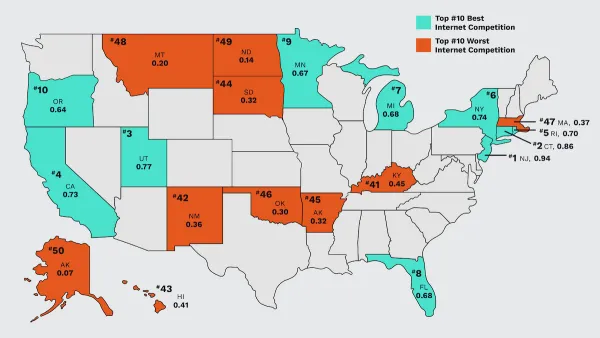
Do You Live in an ISP Monopoly?
Almost 9 million Americans live in an area with only one option for internet providers.

Housing Providers Build Bridges Over the Digital Divide
Internet connectivity has become as important as basic utilities, but millions of people who live in affordable housing still lack access to devices and connections. Housing managers are finding innovative ways to fix that.

Planetizen Federal Action Tracker
A weekly monitor of how Trump’s orders and actions are impacting planners and planning in America.

‘Going backwards:’ Baltimore mayor, students rally against state's transit funding plan
Maryland's proposed six-year plan provides no funding for Baltimore’s BMORE bus program and reduces its road maintenance funding.

Detroit to transform waterfront with $2.2 billion investment
Developers will convert about 18 acres of unused parking lot space into civic spaces.

U.S.-Iran war may have ‘devastating’ impact on cost to warm homes
Vermont and Maine residents may see a 76% increase in the cost of warming their homes this winter.

Senate bill would ‘overhaul’ environmental permitting laws
Under the proposed act, government agencies would also not be able to suspend or rescind permits after granting them.

Exemption applications for NYC’s pied-à-terre tax see 55% success rate
The city sent nearly 40% of its initial pied-à-terre tax warnings erroneously.

FREE Course: Walkable City 1: Why Walkability?
After describing his path towards focusing on walkability as the essence of good planning, Jeff Speck marches through his five principal reasons for making more walkable places.
Reinventing Malls: Planning Alchemy—Turning Gray Fields Into Gold
The course focuses on the opportunities and imperatives that shape reinvention of mall sites.

One Hundred Miles
County of Mendocino
planning NEXT
The Architects Foundation
University of Cincinnati Online
Montrose County
Northern Illinois Transit Authority (NITA)
The Pocatello Development Authority