An historic agreement between Israel, Jordan and the Palestinians aims to slow the disappearance of the Dead Sea and stabilize the supply of drinking water for all three groups.


A memorandum of understanding signed at the World Bank headquarters in Washington this week, "will help save the Dead Sea; supply water and later electricity; and bring about 'strategic, economic and political cooperation,' said [Silvan Shalom, Israel’s water and energy minister], who said he hoped it would serve as a 'window for regional peace.'"
Under the agreement, drinking water provided by a new desalination facility on the Red Sea in Aqaba, Jordan will be shared by Israel and Jordan. "In addition to the desalination facility, a 112-mile pipeline would convey brine from the Aqaba plant to partially replenish the shrinking Dead Sea, a hyper-saline body of water," reports Batsheva Sobelman.
“This is a historic agreement that realizes a dream of many years,” said Shalom. “The agreement is of the highest diplomatic, economic, environmental and strategic importance.”
Read the full story: Israel, Jordan and Palestinians sign accord on water cooperation


Will Israel Show Us the Way Out of the Pandemic?
If vaccinations are key to ending the pandemic, Israel may get there first as it has the highest rate by far of any nation. Paradoxically, it also has the world's second-highest rate of daily new COVID-19 cases.
Illegal Palestinian Solar Installations Set For Demolition
Over the past two years, German funding and Israeli philanthropy led to the construction of solar installations for Palestinians living in "Area C" in the West Bank. Now Israel says the panels are illegal and wants them demolished.
Bridge Planned Between Egypt and Saudi Arabia
A proposed 20-mile bridge would span the Red Sea to connect Egypt and Saudi Arabia -- connecting Arab states and reducing reliance on land passage through Israel.

Planetizen Federal Action Tracker
A weekly monitor of how Trump’s orders and actions are impacting planners and planning in America.

Chicago breaks ground on $3 billion megadevelopment
The new neighborhood, titled Foundry Park, will one day host 3,700 residences.
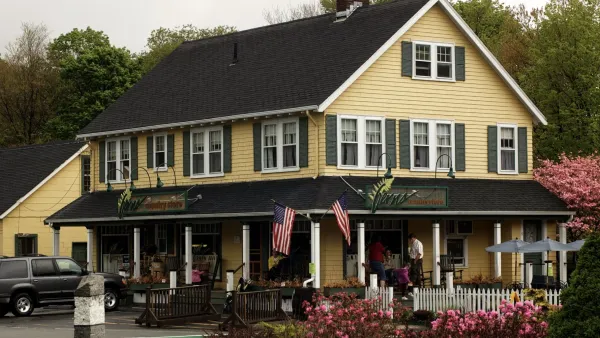
This MA town is drowning in its own sewage — and residents like it that way
Susan Murcott, a waste water expert, said if Carlisle didn't address their leaking sewage, the problem could turn “deadly.”

Amtrak cuts ribbon on Seattle Airo maintenance facility
The $250 million, nearly 100,000-square-foot building can house an entire Cascades Airo trainset.

To power data centers, Google seeks autonomous control of thousands of homes’ electricity
The tech company has signed a deal to indirectly pay Mid-Atlantic residents to reduce their power demand when the grid is strained.

From robotaxis to robotrains: LA, DC weigh driverless transit
If approved, the projects will take years to implement and face financial and technical hurdles.

FREE Course: Walkable City 1: Why Walkability?
After describing his path towards focusing on walkability as the essence of good planning, Jeff Speck marches through his five principal reasons for making more walkable places.
Reinventing Malls: Planning Alchemy—Turning Gray Fields Into Gold
The course focuses on the opportunities and imperatives that shape reinvention of mall sites.

City of Rosemead
Rutgers University, Edward J. Bloustein School of Planning and Public Policy
One Hundred Miles
The Architects Foundation
University of Cincinnati Online
Montrose County
The Pocatello Development Authority
The Urban Renewal Agency of the City of Pocatello