At the height of America's suburban expansion, a children's show premiered that was set in a dense urban environment. Steve Patterson wonders if the young adults now embracing urban lifestyles learned to love cities by watching Sesame Street.



Patterson has a very personal take on his experience watching the influential children's television series Sesame Street, but wonders if that perspective is shared by other adults of his generation that grew up in the suburbs. After all, notes Wikipedia, "In 2008, it was estimated that 77 million Americans had watched the series as children."
"My family moved into a brand new home in suburban Oklahoma City just months before I was born. Our subdivision lacked sidewalks, we had a 9-car driveway (3×3)," writes Patterson. "Watching Sesame Street though, I knew there was another way to live. I’m not sure when I got too old for Sesame Street, but the images of the conversations on the front stoop stayed in my memory. Looking back, I think Sesame Street gave me a very positive image of urban neighborhoods."
Though some of those commenting on his post disagree with Patterson's premise, early results of an accompanying poll tend to support the ubiquity of his experience.
Read the full story: Poll: How Did Sesame Street Influence Your Childhood Perceptions of Urban Neighborhoods?

Creating Suburban Exclusivity in the City
City life is being sold as a convenient version of the suburbs, with similar amenities minus the time-consuming commute.
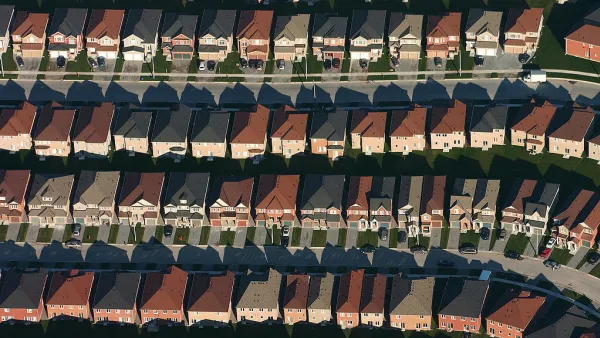
Why Millennials Might Save the Suburbs
Observers have anxiously wondered what will happen to America's urban revival as Millennials start families and seek the types of amenities more readily found in the suburbs. Relax, says Shane Phillips, cities will be fine and suburbs will be better.
Cities vs Suburbs: Where do Parents Want to Raise Their Children?
Tanya Snyder wades into the ongoing discussion over whether America's urban revival can be sustained, a question that essentially hinges on whether cities are creating an attractive alternative to the suburbs for raising children.

Planetizen Federal Action Tracker
A weekly monitor of how Trump’s orders and actions are impacting planners and planning in America.

California plans to bury El Niño’s downpour
If the state plays its cards right, it may be able to store a billion acre-feet of El Niño’s water in aquifers.

Desperate measures: Advocates weigh draining Lake Powell to fill Colorado River
Draining the reservoir could reduce evaporation losses by a couple hundred thousand acre-feet.

Los Angeles just elected an urban planner as its mayor
Transportation analysts are optimistic that Raman will be more aggressive in addressing transit issues than Bass.

Mamdani’s pied-à-terre tax survives legal challenge
A panel of judges found that the plaintiffs failed to demonstrate injury as a result of New York City's implementation of the tax.

Eastern Nebraska is running out of electricity
Data centers and electrification are straining eastern Nebraska’s grid, throttling economic development.

FREE Course: Walkable City 1: Why Walkability?
After describing his path towards focusing on walkability as the essence of good planning, Jeff Speck marches through his five principal reasons for making more walkable places.
Reinventing Malls: Planning Alchemy—Turning Gray Fields Into Gold
The course focuses on the opportunities and imperatives that shape reinvention of mall sites.

City of Rosemead
Rutgers University, Edward J. Bloustein School of Planning and Public Policy
One Hundred Miles
University of Michigan School for Environment and Sustainability (SEAS)
Hunter College, City University of New York (CUNY)
The Architects Foundation
City of Cambridge
Montrose County
The Pocatello Development Authority