Visionary developer James W. Rouse always wanted his planned community in Howard County, Maryland to be a "real city". As Columbia nears 50, a 30-year plan and new development seeks to fill in the community's "doughnut hole" with walkable density.


"Fifty years after [James W.] Rouse announced that his company had bought 14,100 acres in Howard County and was going to build a planned community, the latest effort to fulfill that aspiration has just begun," reports Arthur Hirsch. "Construction sites have sprung up from the northwest side of The Mall in Columbia down to the edge of Lake Kittamaqundi as part of a 30-year plan to remake the Town Center into a more walkable space with more apartment buildings, offices and stores."
"'Columbia has not achieved its full potential yet, and it won't achieve it until there is an alive downtown. ... That's the missing piece,' said Padraic Kennedy, who was Rouse's choice to be the first president of the Columbia Association, the nonprofit organization that maintains open space and an array of community services, swimming pools and recreation centers."
FULL STORY: At 50, vision for Columbia is still a work in progress

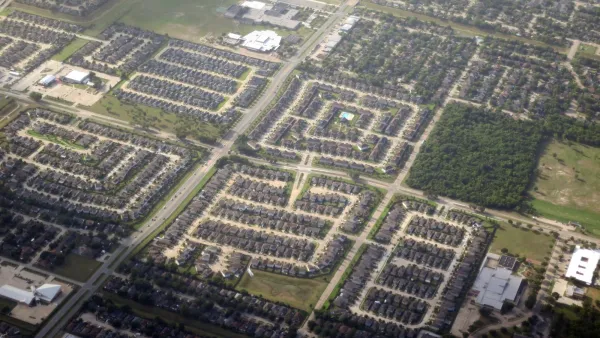
Houston Area's Center of Gravity Shifts Outside the Loop
The population center of Harris County is now outside central Houston, a shift that occurred over the last two decades as the region's suburbs blossomed.
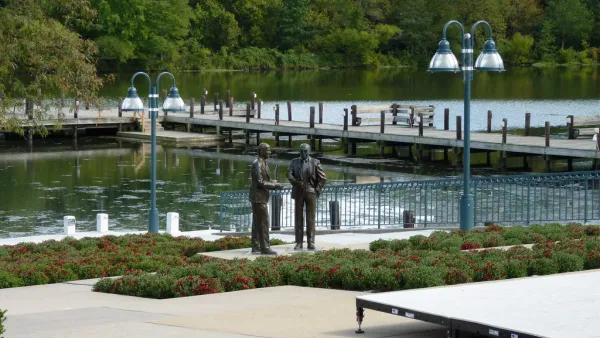
60 Years On, the Planned City of Columbia, Maryland Holds Up Against Change
The design for the planned city of Columbia, Maryland continues to influence new developments around the world.
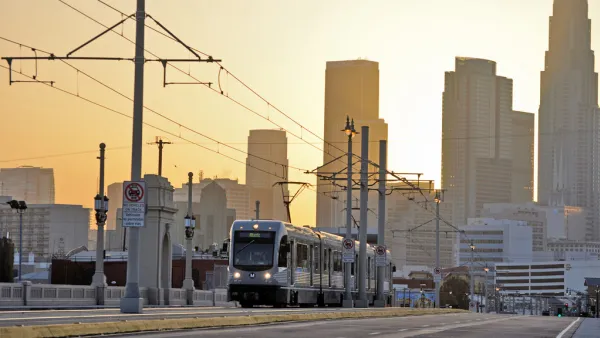
Where Los Angeles Equals San Francisco's Density
Though the Los Angeles region is very dense, significant barriers to transit-oriented planning remain. Based on this analysis, the lack of a central urban core shouldn't be one of them.

Planetizen Federal Action Tracker
A weekly monitor of how Trump’s orders and actions are impacting planners and planning in America.

The state-sanctioned urbicide of Austin
People don’t kill cities. Freeways do.

US to reduce Colorado River water deliveries to Mexico
A new Colorado Treaty amendment reduces Mexico’s Colorado River water allocation by 250,000 acre feet.

Guerilla urbanists are building DIY bus stop benches in Chicago
A before-and-after of one of the bus stops with a new bench. The new benches are not officially sanctioned or permitted, but the residents who placed them hope they will be the start of a network of DIY benches across the city.

Mamdani overhauls NYC's Vision Zero plan with 100 new policy goals
The overhaul aims to reduce traffic deaths and make streets safer for pedestrians, cyclists and drivers through lower speed limits, new safety infrastructure and more.

Amtrak not solely to blame for New Jersey commuter rail's unreliability, report finds
A new study from the Garden State Initiative found that NJ Transit’s budget grew 20% across a 4 year period, but reliability declined significantly over the same period.

FREE Course: Walkable City 1: Why Walkability?
After describing his path towards focusing on walkability as the essence of good planning, Jeff Speck marches through his five principal reasons for making more walkable places.
Reinventing Malls: Planning Alchemy—Turning Gray Fields Into Gold
The course focuses on the opportunities and imperatives that shape reinvention of mall sites.

Eagle County Government
Harvard University Graduate School of Design
Nashville Planning Department
The Architects Foundation
University of Cincinnati Online
The Pocatello Development Authority
The Urban Renewal Agency of the City of Pocatello
Journal of the American Planning Association