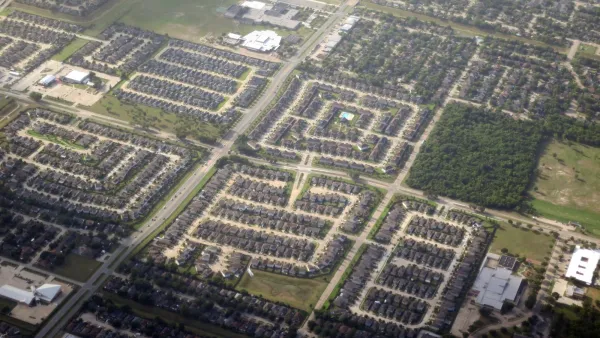
If the small city of Otsego, located 30 miles from Minneapolis, is a guide, sprawl may be poised to make a comeback as the housing market roars back to life. But larger indicators point to a withdrawal from sprawl.


During the housing bust of the last half-decade, suburban and edge developments were among the hardest hit by the decline in home prices and dip in construction, while the attraction of inner suburbs and urban centers held strong.
Accordingly, during this time, "[t]he price of sprawl has become been increasingly undeniable," writes Shaila Dewan. "Moderate-income families have seen their transportation costs balloon to more than a quarter [PDF] of their income. Cities have discovered that low-density developments fail to pay for their own infrastructure. More recently, a new study of economic mobility suggested that sprawl, and its accompanying lack of transportation options, prevented access to higher paying jobs."
"Undoubtedly, cities have undergone a resurgence, bringing bike lanes and car-sharing, mixed-use rezoning and luxury rentals into vogue," she adds. "But some question remains as to how sweeping the change has been. In 2011, the National Association of Home Builders’ members reported that they expected their customers’ ideal home size to shrink. But the median home size in the country has continued to rise, reaching a record high in 2012 [PDF]."
Read the full story: Is Suburban Sprawl on Its Way Back?

How to Fix Racist Housing Policies: Sue the Suburbs
Strengthening U.S. Department of Housing and Urban Development's civil rights enforcement could send a powerful signal to communities resistant to changing discriminatory housing rules.
The Problems With Suburbs Are Numerous. Is a Change of Course Possible?
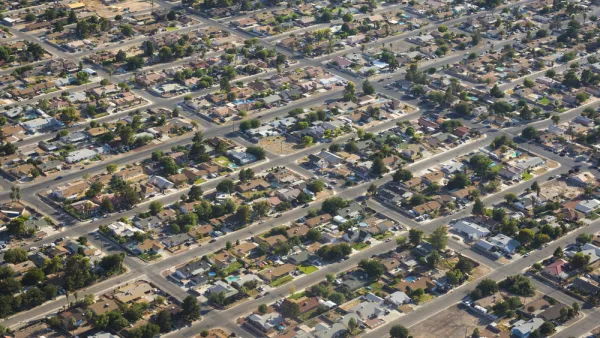
American suburbs are growing, and understanding the evolution of suburban sprawl is a useful guide for the future.

Homebuyers Return to the Exurbs
It's been a while since 2008, and a new crop of homeowners is colonizing the far-flung exurbs. Mostly foreclosed and even abandoned last time around, the exurbs are still a risky buy.

Planetizen Federal Action Tracker
A weekly monitor of how Trump’s orders and actions are impacting planners and planning in America.

Amtrak, CN end decades-long dispute with eight-year agreement
The new operating agreement establishes an updated framework for the companies to work together, including processes to resolve disputes.

Judges permit Denver to divert 77,000 acre feet from the Colorado River for reservoir expansion
Overuse and climate change have caused the Colorado River’s water levels to plummet.

NYC DOT wants faster, more permanent street upgrades
The city is examining ways to build more concrete infrastructure without getting entangled in 'decades-long' projects.

'Something we’ve never seen before:' rising utility rates could strain city finances nationwide
Data centers, climate change and other factors have caused utility rates in the United States to increase by 38% since 2020.

Trump to overrule local leaders, lease millions of acres of America’s Pacific Island territories’ seafloors to mining companies
International law says that the Indigenous people of America’s territories have a right to prior and informed consent regarding projects that impact their countries.

FREE Course: Walkable City 1: Why Walkability?
After describing his path towards focusing on walkability as the essence of good planning, Jeff Speck marches through his five principal reasons for making more walkable places.
Reinventing Malls: Planning Alchemy—Turning Gray Fields Into Gold
The course focuses on the opportunities and imperatives that shape reinvention of mall sites.

Harvard University Graduate School of Design
KFH Group Inc.
Greater Baltimore Committee
The Architects Foundation
University of Cincinnati Online
The Pocatello Development Authority
The Urban Renewal Agency of the City of Pocatello