Ever wish your nearby park could follow you throughout the city, providing open space wherever you might be? An artist and landscape architect have created Parkcycle Swarm, a modular system of 'human powered mobile gardens'.


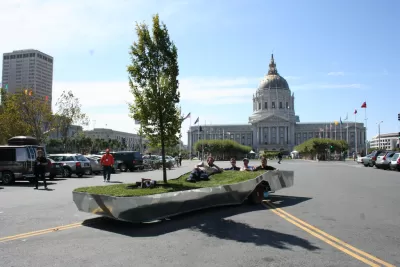
"What if communities formed new parks when they needed them? What if these parks could be formed by swarms of bicycles? If that sounds like something out of a sci-fi novel, get ready because landscape architect John Bela, ASLA, at Rebar and artist Tim Wolfer at N55 have created Parkcycle Swarm," writes Jared Green.
"San Francisco-based urban design and art firm Rebar first tested the Parkcycle concept for one of its famed Park(ing) Days," he explains. "They describe the system as a 'human-powered open space distribution system designed for agile movement within the existing auto-centric urban infrastructure.'”
"N55, a Copenhagen-based public art group, sees each unit as modules in a broader system. 'The Parkcycle Swarm can be seen as a DIY urban planning tool that is as an alternative to the top down urban planning that dominates most cities in the world.'"
Read the full story: Park by Swarm

Minneapolis Activists Use DIY Traffic Circles to Identify, Slow ICE
Residents are using the pop-up roundabouts to slow traffic and make their presence known on Minneapolis streets.
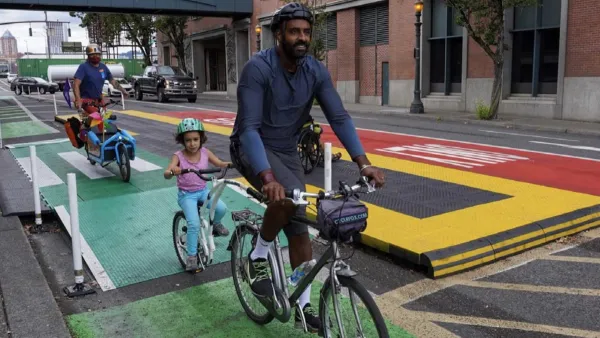
Portland Launches Tool for DIY Community Road Safety Interventions
A set of resources offers safety data and guidance for putting low-cost, quick-build interventions into action.
Guerilla Urbanism Spurs Action From Cities
Rather than take a hostile approach to DIY urbanism, some cities are using guerilla efforts as an opportunity to understand critical infrastructure gaps.

Desperate measures: Advocates weigh draining Lake Powell to fill Colorado River
Draining the reservoir could reduce evaporation losses by a couple hundred thousand acre-feet.

Eastern Nebraska is running out of electricity
Data centers and electrification are straining eastern Nebraska’s grid, throttling economic development.

Malls are becoming the midtowns of the future
Mall and office park redevelopments are a generational opportunity to create new nodes of urbanity.

NYC breaks ground on anti-flooding infrastructure project
New York City's new system will reduce stormwater flows to local sewers by 90%.

One Kentucky town’s secret to affordable housing
The Smoketown Community Land Trust has already built seven affordable homes for community members.

Houston gains petal-shaped cooling infrastructure to make streets more ‘delightful’
The city has installed the pavilions along 15 blocks in Houston.

FREE Course: Walkable City 1: Why Walkability?
After describing his path towards focusing on walkability as the essence of good planning, Jeff Speck marches through his five principal reasons for making more walkable places.
Reinventing Malls: Planning Alchemy—Turning Gray Fields Into Gold
The course focuses on the opportunities and imperatives that shape reinvention of mall sites.

City of Rosemead
Rutgers University, Edward J. Bloustein School of Planning and Public Policy
One Hundred Miles
University of Michigan School for Environment and Sustainability (SEAS)
Hunter College, City University of New York (CUNY)
The Architects Foundation
City of Cambridge
Montrose County
The Pocatello Development Authority