Federal requirements often aren't enough incentive for municipalities to create accessible playgrounds, so parent advocates are paving the way for kids with special needs to access playgrounds.


The Americans with Disabilities Act now includes provisions for play areas that are accessible to people with disabilities, but cash-strapped governments are reluctant to take on the cost. "The higher cost of 'inclusive' playgrounds means many local governments can't afford them. And in places that do offer the kind of shared playing experience contemplated by the ADA, a group of frustrated parents are typically behind it all," reports Robert Benincasa.
However, the opportunity to participate in play with other children is an important part of childhood that kids with disabilities need. "'Play areas are not just places where kids have fun,' says Eve Hill, a civil rights lawyer with the Justice Department, which enforces the ADA."
"'They are places where kids learn to interact with the world, and with each other,' Hill says. That places playgrounds in the same category as other civil-rights touchstones [such as swimming pools and lunch counters]."
Now, many parent advocates are raising money to create playgrounds that all kids can enjoy, like Brooklyn's Playground in Pocatello, Idaho, described by parent Jonny Fisher: "'We have the therapeutic swings,' Fisher says. 'These have got backs, so kids that don't have that muscle tone can get in there completely, and feel safe and secure and swing.'"
"'We have ramps leading up to all the play structures. You have the solid surfaces throughout the entire playground. With walkers or wheelchairs it's very easy to go around this.'"
Read the full story: For Kids With Special Needs, More Places to Play

Historic Queens park is getting a $120M upgrade
The borough's largest park will undergo significant upgrades for accessibility, flood mitigation and historic preservation.
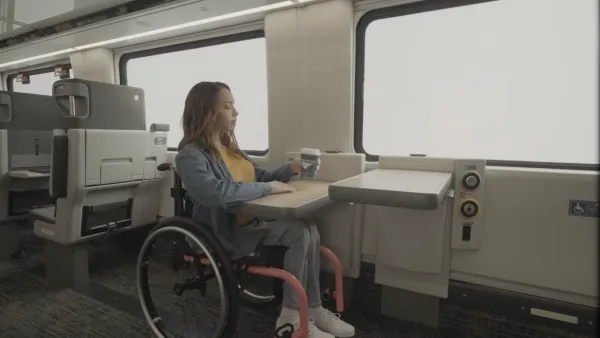
Amtrak makes over 160 stations fully accessible
Upgrades include new elevators, signage and accessible restrooms.

Look North: 3 ways Canadian planners are crushing digital accessibility
Although accessibility regulations look similar in the United States and Canada, our northern neighbors have managed to make planning materials more usable for people with disabilities. Here's what we can learn from them.

Planetizen Federal Action Tracker
A weekly monitor of how Trump’s orders and actions are impacting planners and planning in America.

California plans to bury El Niño’s downpour
If the state plays its cards right, it may be able to store a billion acre-feet of El Niño’s water in aquifers.

Desperate measures: Advocates weigh draining Lake Powell to fill Colorado River
Draining the reservoir could reduce evaporation losses by a couple hundred thousand acre-feet.

US buildings threatened, destroyed by fires set to triple by 2060
Researchers found a high fire risk for socioeconomically vulnerable neighborhoods in the American West.

LA residents may be allowed to paint their own crosswalks
Councilwoman Katy Yaroslavsky put out a motion instructing the Los Angeles Department of Public Transportation to study the feasibility of allowing volunteers to paint crosswalks.

Dallas moves to overhaul its zoning code
The city's zoning reform will allow more multi-family and mixed-use developments.

FREE Course: Walkable City 1: Why Walkability?
After describing his path towards focusing on walkability as the essence of good planning, Jeff Speck marches through his five principal reasons for making more walkable places.
Reinventing Malls: Planning Alchemy—Turning Gray Fields Into Gold
The course focuses on the opportunities and imperatives that shape reinvention of mall sites.

City of Rosemead
Rutgers University, Edward J. Bloustein School of Planning and Public Policy
One Hundred Miles
Hunter College, City University of New York (CUNY)
The Architects Foundation
University of Cincinnati Online
City of Cambridge
Montrose County
The Pocatello Development Authority