"Nearly all the rich world’s industrial cities fell on hard times between 1950 and 1980," says The Economist. Why did some recover while others failed? A new paper argues that skilled workers and a diverse economy are key to overcoming adversity.


"The Motor City is an extreme example of a decline that has beset industrial cities across America’s Midwest and northern Europe," notes The Economist. "Nearly all the rich world’s industrial cities fell on hard times between 1950 and 1980, but some, including Boston, New York and London, rebounded soon after. Hardscrabble places like Baltimore, Pittsburgh and Liverpool have also enjoyed revivals."
"In a new paper [PDF] Gilles Duranton of the University of Pennsylvania and Diego Puga of the Centre for Monetary and Financial Studies in Madrid suggest that a pool of skilled workers and a diverse economy are among the best predictors of long-run success. Such characteristics offer cities the best hope of stumbling on new sources of increasing returns to scale."
Read the full story: Down towns

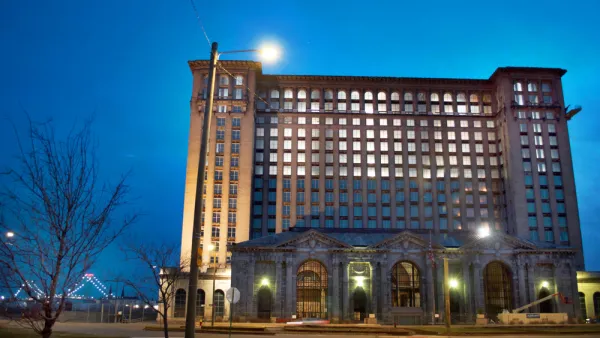
Economic Recovery in Legacy Cities
Americans living in legacy cities face a unique set of challenges and opportunities in recovering from the COVID-19 pandemic. Several local, state, and federal support strategies could aid these cities in recouping losses.
Where Population Declines but the Economy Grows
While the scale of Detroit's population loss is well known, the lesser known that the city's economy has grown steadily in recent decades. It's not alone.
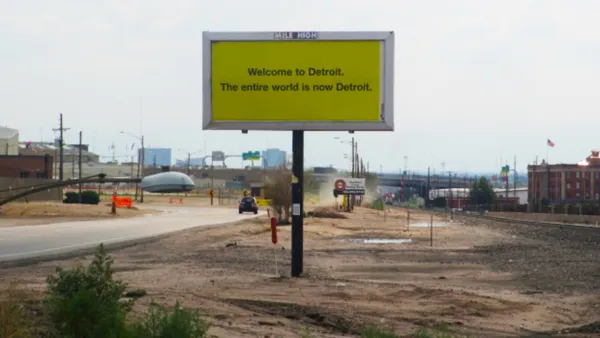
Detroit Still Has More to Worry From Decline Than Gentrification
For every feel-good story about urban revitalization, or more problematic tale of gentrification, the experience in much of Detroit has more to do with decline.

Planetizen Federal Action Tracker
A weekly monitor of how Trump’s orders and actions are impacting planners and planning in America.

Amtrak, CN end decades-long dispute with eight-year agreement
The new operating agreement establishes an updated framework for the companies to work together, including processes to resolve disputes.

Judges permit Denver to divert 77,000 acre feet from the Colorado River for reservoir expansion
Overuse and climate change have caused the Colorado River’s water levels to plummet.

Atlanta City Council unanimously backs $3.5 billion Beltline light rail project
The resolution was drafted after Atlanta Mayor Andre Dickens pulled support for the Atlanta Streetcar extension last year.

SEPTA to bring nearby frequent transit to over 1 million new riders as part of decade-long plan
The agency's Accelerate plan will also bring frequent transit to twice the amount of jobs that are currently located near it.

NYC plants over 18,000 trees, the most new foliage in a decade
Many of the trees were planted in communities vulnerable to extreme heat.

FREE Course: Walkable City 1: Why Walkability?
After describing his path towards focusing on walkability as the essence of good planning, Jeff Speck marches through his five principal reasons for making more walkable places.
Reinventing Malls: Planning Alchemy—Turning Gray Fields Into Gold
The course focuses on the opportunities and imperatives that shape reinvention of mall sites.

City of Thousand Oaks
City of Wisconsin Rapids
Harvard University Graduate School of Design
The Architects Foundation
University of Cincinnati Online
The Pocatello Development Authority
The Urban Renewal Agency of the City of Pocatello