A new study by researchers at Children's and the University of Pennsylvania concludes that, contrary to popular perception, cities are safer than rural or suburban areas. Higher rates of fatal car accidents outside cities are largely to blame.



Marie McCullough explains the findings of a new study published online Tuesday in the Annals of Emergency Medicine that examined fatal injury rates across the United States. "Like previous studies, the new one found that homicide rates are higher in cities than the boonies. (Suicide rates were not significantly different.) But the new analysis defied the prevailing perception that cities are innately more dangerous than remote areas. The most rural counties had the highest rate of fatal injuries - 74 deaths per 100,000 residents - compared with 50 deaths per 100,000 in the most urbanized counties."
"People who are considering moving out of cities because of safety concerns may want to 'reexamine their motivations,'" said lead researcher Sage Myers, an emergency medicine physician at Children's Hospital of Philadelphia.
What accounts for the difference? Cars, says McCullough, "the leading cause of accidental death everywhere."
"Crashes caused 28 deaths per 100,000 residents in the most rural counties, compared with 11 deaths per 100,000 in the biggest cities."
Read the full story: It's safer in cities, but not in Phila.

Cars, Kids, and a Safer Environment Through Planning
Urban areas are filled with cars, and this creates an unsafe environment for children. This commentary argues that officials need to regain their faith in the power of planning to address the issue.

Thrift stores, public libraries and genderless bathrooms: How public amenities become trans infrastructure
Amenities like ample public transit, affordable retail and non-gendered bathroom spaces can make cities more safe and welcoming for transgender residents — and everyone else.
How urban design can deter crime
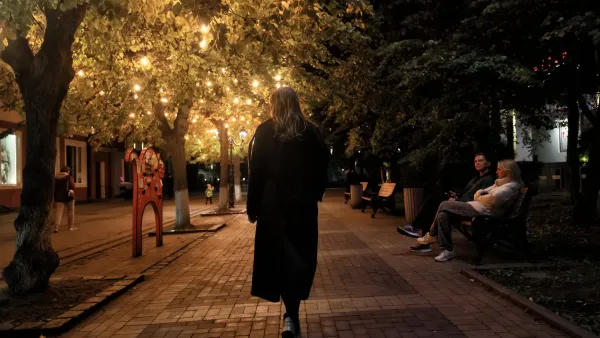
Well-designed public spaces and good lighting can prevent crime and make residents feel safer.

Planetizen Federal Action Tracker
A weekly monitor of how Trump’s orders and actions are impacting planners and planning in America.

Amtrak, CN end decades-long dispute with eight-year agreement
The new operating agreement establishes an updated framework for the companies to work together, including processes to resolve disputes.

Judges permit Denver to divert 77,000 acre feet from the Colorado River for reservoir expansion
Overuse and climate change have caused the Colorado River’s water levels to plummet.

NYC DOT wants faster, more permanent street upgrades
The city is examining ways to build more concrete infrastructure without getting entangled in 'decades-long' projects.

'Something we’ve never seen before:' rising utility rates could strain city finances nationwide
Data centers, climate change and other factors have caused utility rates in the United States to increase by 38% since 2020.

Trump to overrule local leaders, lease millions of acres of America’s Pacific Island territories’ seafloors to mining companies
International law says that the Indigenous people of America’s territories have a right to prior and informed consent regarding projects that impact their countries.

FREE Course: Walkable City 1: Why Walkability?
After describing his path towards focusing on walkability as the essence of good planning, Jeff Speck marches through his five principal reasons for making more walkable places.
Reinventing Malls: Planning Alchemy—Turning Gray Fields Into Gold
The course focuses on the opportunities and imperatives that shape reinvention of mall sites.

Harvard University Graduate School of Design
KFH Group Inc.
Greater Baltimore Committee
The Architects Foundation
University of Cincinnati Online
The Pocatello Development Authority
The Urban Renewal Agency of the City of Pocatello