Art, architecture, and incarceration collide in essays on prison design from the Panopticon to the Golden Gulag.


As unprecedented hunger strikes continue at Guantánamo Bay and in California federal prisons, two recent features on Places explore the politics and aesthetics of prison design.
In an essay adapted from his book Corrections and Collections, Joe Day compares the proliferation of American prisons and museums since the 1960s and finds intriguing parallels in how institutional architectures have responded to cultural movements from Minimalism to post-Millenialism. Art and crime collide in buildings from Jeremy Bentham's Panopticon through Frank Lloyd Wright's Guggenheim to contemporary work by Peter Zumthor, Rem Koolhaas and others.
In Geographies of Detention, adapted from an exhibition at the California Museum of Photography, Catherine Gudis and Molly McGarry present art and documentary work, by Sandow Birk, Alyse Emdur, Richard Ross and the Guantánamo Public Memory Project, that investigates prison landscapes.
Read the full story: Corrections and Collections
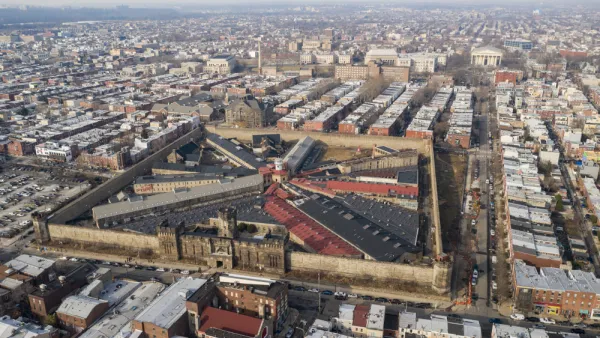
Eastern State Penitentiary: A Class about the Past Speaks to the Present and the Future
Built as an embodiment of the ideals of prison reformers, the Eastern State Penitentiary had running water and central heating before the White House, and housed the first synagogue built in an American prison.
Do the 'Art Everywhere' Billboards Support Art, or Advertising?
With so many eyes trained obsessively on mobile phones, the outdoor industry is supporting a campaign to place famous art on billboards around the country. Will people notice? Should they?

Coming to a Billboard Near You: The 'Art Everywhere' Project
Voting for a new project called "Art Everywhere" is currently open to the public on works from five of the country’s largest and most respected museums. The vote will help decide which images get placed on some 50,000 billboards this summer.

Washington state to charge fee to drivers with fuel-efficient cars
Revenue from the fee will go towards supporting the state’s highways.

Illinois considers spending $1 billion in taxpayer money on data center
A quantum computing campus and data center are currently under construction in Chicago.

Trump to blast ‘hydrocarbon highway’ through ‘world’s longest art gallery’
Environmental and historic preservation groups are suing to stop the project.

NYC, state sue feds over mixed-immigration-status housing assistance rule
The state’s lawsuit argues that the rule change violates the Administrative Procedure Act.

Michigan to turn neighborhood into virtual power plant
Residents will soon be able to divert their excess energy to the grid in exchange for compensation.

Data center, mining project swarm to long-awaited Alaska railroad line
The state-owned railroad approved final plans for the spur line this week; the project is expected to cost $311 million, mostly funded by the federal government

FREE Course: Walkable City 1: Why Walkability?
After describing his path towards focusing on walkability as the essence of good planning, Jeff Speck marches through his five principal reasons for making more walkable places.
Reinventing Malls: Planning Alchemy—Turning Gray Fields Into Gold
The course focuses on the opportunities and imperatives that shape reinvention of mall sites.

City of Charlotte
City of Rosemead
Rutgers University, Edward J. Bloustein School of Planning and Public Policy
University of Michigan School for Environment and Sustainability (SEAS)
Hunter College, City University of New York (CUNY)
The Architects Foundation
University District Partnership