Published to coincide with World Refugee Day, Smithsonian has assembled an interactive map of the 50 largest refugee camps in the world. Many of the camps, which together house 1.9 million people, are comparable in size to medium-sized U.S. cities.


"Today, about 45.2 million refugees [PDF] are scattered around the world, a record high in nearly two decades," writes Marina Koren. "Of those, 80 percent are women and children. For 34 million of them, the United Nations High Commission on Refugees offers protection and life-saving supplies at refugee camps in more than 125 countries."
"Despite the terminology used—'camps' or 'settlements'—many are not temporary; some have existed for years, and for many young refugees, these camps are the only homes they know," she adds. "The Dadaab complex in Kenya, which includes the three biggest camps in the world, was constructed in the early 1990s. The largest of the three, Hagadera, houses 138,102 refugees, which is equivalent to the population of Pasadena, California. For each camp on the map, a comparable American city is listed to convey size."
Read the full story: Where Are the 50 Most Populous Refugee Camps?

Ikea Unleashes its Flat Pack Expertise on Emergency Shelters
A cheap, solar-powered hut designed by Ikea, in partnership with the United Nations High Commissioner for Refugees, promises to revolutionize emergency housing for displaced persons.

Aerial Cable Cars as Urban Transport
While often thought of as only for tourists in mountain areas, aerial cable cars have proven to be effective in providing transportation in urban areas, such as across rivers in New York City and freeways in Portland.
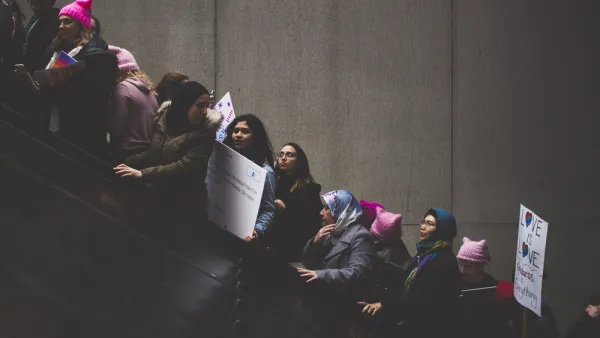
Breaking the Bias on Public Transport
How gender-sensitive data collection can make public transit safer for women.

Planetizen Federal Action Tracker
A weekly monitor of how Trump’s orders and actions are impacting planners and planning in America.

Amtrak, CN end decades-long dispute with eight-year agreement
The new operating agreement establishes an updated framework for the companies to work together, including processes to resolve disputes.

Judges permit Denver to divert 77,000 acre feet from the Colorado River for reservoir expansion
Overuse and climate change have caused the Colorado River’s water levels to plummet.

NYC plants over 18,000 trees, the most new foliage in a decade
Many of the trees were planted in communities vulnerable to extreme heat.

New bill requires California data center developers to create water scarcity plans
Gov. Gavin Newsom recently signed 7 bills intended to give California communities more information about the impact of proposed data centers.

San Diego may kill one-third of its bus routes as budget crisis looms
Under the city's proposed plan, 21% of Metropolitan Transit System riders would lose access to transit services.

FREE Course: Walkable City 1: Why Walkability?
After describing his path towards focusing on walkability as the essence of good planning, Jeff Speck marches through his five principal reasons for making more walkable places.
Reinventing Malls: Planning Alchemy—Turning Gray Fields Into Gold
The course focuses on the opportunities and imperatives that shape reinvention of mall sites.

City of Wisconsin Rapids
Harvard University Graduate School of Design
KFH Group Inc.
The Architects Foundation
University of Cincinnati Online
The Pocatello Development Authority
The Urban Renewal Agency of the City of Pocatello