After Gustave Eiffel turned down an opportunity to build a landmark tower for London, railway magnate Sir Edward Watkin held a world-wide competition to design the icon instead. "Stevie SW9", at Brixton Buzz, explores some of the spectacular entries.


"Back in the late Victorian period, railway magnate Sir Edward Watkin decided what London really needed was a massive tower to eclipse the famous Eiffel Tower in Paris," says Stevie. After Eiffel declined the opportunity, "Watkin opened up the design to public competition, and thanks to the rather excellent Public Domain Review it’s now possible to view the kind of weird and wonderful landmarks designers had in mind for London – including some entries from south Londoners."
"No less than 68 designs were submitted, many showing off the full reign of imagination, ambition and, in some cases, sheer madness of the white heat of the Victorian age," he writes.
Construction actually began on the winning design submitted by Stewart, MacLaren and Dunn in 1892, however technical and financial problems stunted its growth, and Watkin’s death in 1901 "[put] an end to the dream."
Read the full story: Gasp at the south London entries for the 1890 Great Tower Of London competition
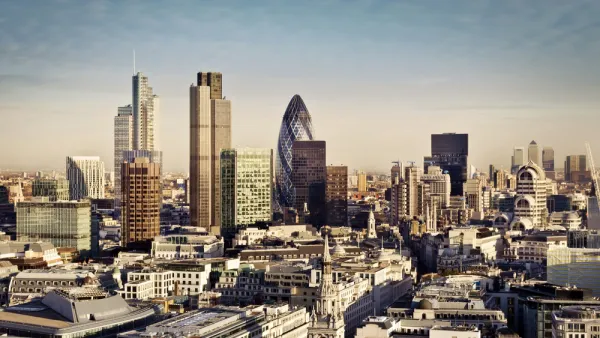
Are Skyscrapers Profitable?
Yes and no, says Peter Bill. As a look at London's delightfully nicknamed towers - the Shard, the Walkie-Talkie, the Cheesegrater - shows, it may take years, and multiple economic cycles for skyscrapers to recoup their investment.
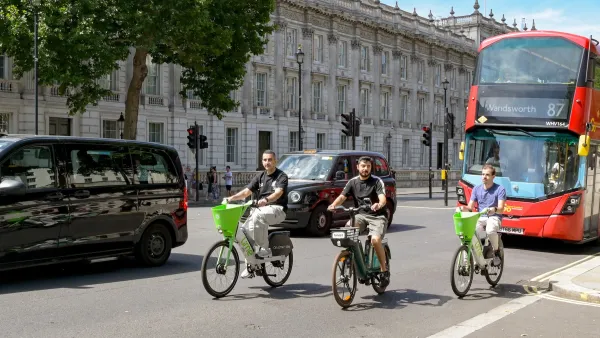
Bike use in London grew by 43% since 2019, but car use remains roughly the same
The city's efforts to reduce car use have stalled despite ambitious programs like congestion pricing and low-traffic neighborhoods.

Beavers save London Tube station from flooding
A small group of beavers is increasing biodiversity and creating cost-free flood mitigation infrastructure.

Planetizen Federal Action Tracker
A weekly monitor of how Trump’s orders and actions are impacting planners and planning in America.

California plans to bury El Niño’s downpour
If the state plays its cards right, it may be able to store a billion acre-feet of El Niño’s water in aquifers.

Desperate measures: Advocates weigh draining Lake Powell to fill Colorado River
Draining the reservoir could reduce evaporation losses by a couple hundred thousand acre-feet.

Mamdani’s pied-à-terre tax survives legal challenge
A panel of judges found that the plaintiffs failed to demonstrate injury as a result of New York City's implementation of the tax.

Eastern Nebraska is running out of electricity
Data centers and electrification are straining eastern Nebraska’s grid, throttling economic development.

Seattle passes record-breaking transit services expansion
Proposition 1 will double the city’s transit tax to add 95,000 more bus trips and preserve 180,000 bus trips annually.

FREE Course: Walkable City 1: Why Walkability?
After describing his path towards focusing on walkability as the essence of good planning, Jeff Speck marches through his five principal reasons for making more walkable places.
Reinventing Malls: Planning Alchemy—Turning Gray Fields Into Gold
The course focuses on the opportunities and imperatives that shape reinvention of mall sites.

City of Rosemead
Rutgers University, Edward J. Bloustein School of Planning and Public Policy
One Hundred Miles
University of Michigan School for Environment and Sustainability (SEAS)
Hunter College, City University of New York (CUNY)
The Architects Foundation
City of Cambridge
Montrose County
The Pocatello Development Authority