Jon Hilkevitch details the roll-out of the Second City's first bike-share system. The handsome three-speed bikes painted in "Chicago blue" will start appearing on city streets in June.


Nearly a year after it was scheduled to launch, Chicago's new bike-share system will debut this June, officials announced this week. "Operating under the name Divvy, which is intended to convey the idea of sharing bikes, the system will start out with about 75 solar-powered docking stations in the downtown and River North areas and expand within a year to 400 stations and about 4,000 bicycles covering much of the city, according to the Chicago Department of Transportation."
"The new transportation option is especially geared toward Metra and CTA commuters looking for a fast and inexpensive way to travel the final mile or less of their daily trips between train stations and offices, officials said." Hence, "[m]any of the first bike-sharing docking stations will be near Union Station, the Ogilvie Transportation Center and CTA rail stations downtown," notes Hilkevitch.
Mayor Rahm Emanuel "said bike sharing represents an important component in the city's overall transportation system."
"We used to only think cars and mass transit," the mayor said. "Today, Milwaukee Avenue is one of the most-biked streets in America. The first protected bike lane in the city, on Kinzie Street, has had a positive impact on the economy."
"He predicted that the bicycle-sharing program 'will open up the neighborhoods to tourists,'" adds Hilkevitch.
Read the full story: Chicago ready to roll out bike-sharing
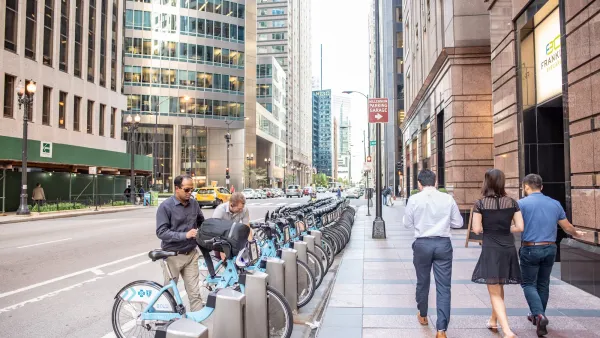
Chicago to Add or Upgrade 200 Bike Share Stations
The Divvy bike share system saw its highest ridership ever in 2025 with 6.8 million trips.
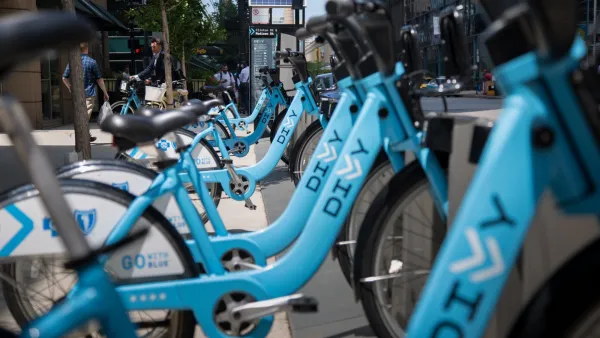
Divvy Introduces E-Bike Charging Docks
New, circular docks let e-bikes charge at stations, eliminating the need for frequent battery swaps.
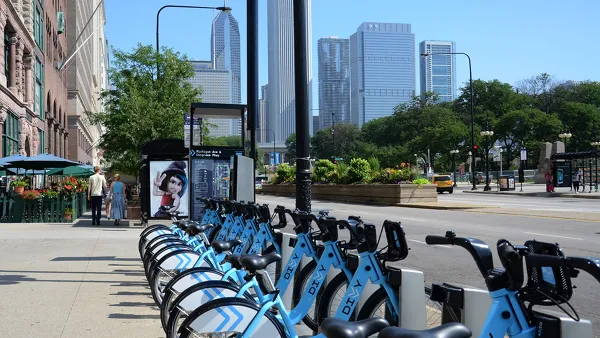
Chicago Bike Share Expands Citywide
Divvy is now available in all 50 wards, with more stations and bikes planned for the system in the next two years.

Planetizen Federal Action Tracker
A weekly monitor of how Trump’s orders and actions are impacting planners and planning in America.

Eastern Nebraska is running out of electricity
Data centers and electrification are straining eastern Nebraska’s grid, throttling economic development.

Study reveals best places in the U.S. for cycling, walking
New research from Streetlight Data examines bicycle and pedestrian miles per capita in the 100 largest U.S. cities by population.

All sides of BRT debate unhappy with CDOT’s most recent move
The Colorado Department of Transportation is no longer considering center-running bus lanes for Colorado Boulevard.

Massachusetts bogs generate both power, and cranberries
Putting solar panels above farmland is one way Massachusetts is advancing toward its goal of net-zero carbon emissions by 2050.

What could the future of LA transit look like under Raman?
The mayor-elect views broken sidewalks and potholes as crises that can be fixed with better governance.

FREE Course: Walkable City 1: Why Walkability?
After describing his path towards focusing on walkability as the essence of good planning, Jeff Speck marches through his five principal reasons for making more walkable places.
Reinventing Malls: Planning Alchemy—Turning Gray Fields Into Gold
The course focuses on the opportunities and imperatives that shape reinvention of mall sites.

City of Rosemead
Rutgers University, Edward J. Bloustein School of Planning and Public Policy
One Hundred Miles
University of Michigan School for Environment and Sustainability (SEAS)
Hunter College, City University of New York (CUNY)
The Architects Foundation
City of Cambridge
The Pocatello Development Authority
The Urban Renewal Agency of the City of Pocatello