A courtesy phone call from the New York City Landmarks Preservation Commission to the owners of a luxury-car showroom designed by Frank Lloyd Wright was seemingly all it took to persuade them to demolish the historic interior.


"For six decades, a luxury-car showroom with a distinctive swooping ramp stood at the corner of Park Avenue and 56th Street. Designed by Frank Lloyd Wright, it was the first of only three New York projects by the modernist master."
Only days after owners of the space received word that the Landmarks Preservation Commission was considering designating the Wright showroom, the dealership was destroyed, reports Matt Chaban.
"'The loss of a Frank Lloyd Wright, it's a national tragedy,' said Simeon Bankoff, director of the Historic Districts Council. Like so many in New York, he had no idea the space was even gone."
"Some question whether there was any Wright worth saving, since the space was renovated twice, first in the 1980s and again in 2001," notes Chaban. "The merits of the space would have been considered at the Landmarks Commission."
"'That's a debate we should have had, and could have had, but now we can't' because of the demolition, said Vin Cipolla, president of the Municipal Art Society. 'That's what the landmarking process is for.'"
Read the full story: Frank Lloyd Wright Park Avenue site wronged
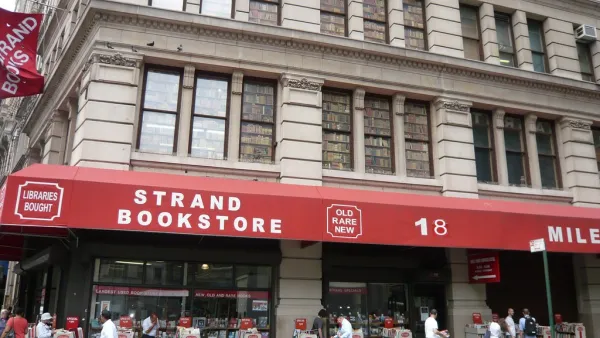
Gentrification Enters Preservation Debate Surrounding NYC's Strand Bookstore
The Renaissance Revival building that houses New York City's beloved Strand Bookstore is under consideration by the city's Landmarks Preservation Commission. The case has provoked debate between rival advocates.
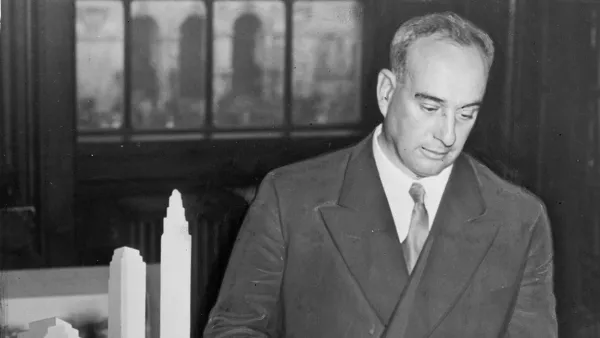
The Robert Moses Nexus to Amazon's Cancellation of Queens HQ2
Last week, Amazon abruptly canceled its decision to invest about $2.5 billion and bring 25,000 high-paying jobs to Queens. A scholar blames their abrupt decision on an arcane state bureaucracy tasked with preventing Robert Moses-like takings.
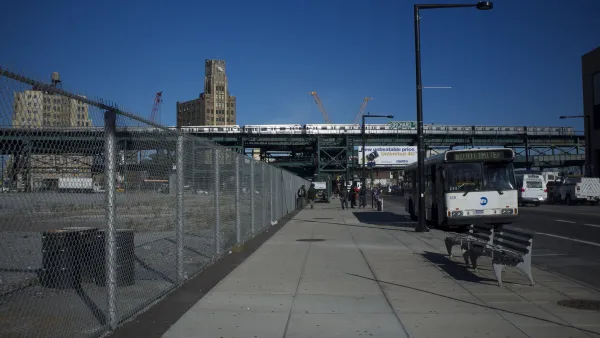
Iconic Queens Clock Tower Anchors 915-Foot Skyscraper
In a complex saga involving the MTA, an 88-year-old tower, and a planned 77-story apartment behemoth, affordable housing may be first to fall by the wayside.

Planetizen Federal Action Tracker
A weekly monitor of how Trump’s orders and actions are impacting planners and planning in America.

California plans to bury El Niño’s downpour
If the state plays its cards right, it may be able to store a billion acre-feet of El Niño’s water in aquifers.

Desperate measures: Advocates weigh draining Lake Powell to fill Colorado River
Draining the reservoir could reduce evaporation losses by a couple hundred thousand acre-feet.

Mamdani’s pied-à-terre tax survives legal challenge
A panel of judges found that the plaintiffs failed to demonstrate injury as a result of New York City's implementation of the tax.

Eastern Nebraska is running out of electricity
Data centers and electrification are straining eastern Nebraska’s grid, throttling economic development.

Seattle passes record-breaking transit services expansion
Proposition 1 will double the city’s transit tax to add 95,000 more bus trips and preserve 180,000 bus trips annually.

FREE Course: Walkable City 1: Why Walkability?
After describing his path towards focusing on walkability as the essence of good planning, Jeff Speck marches through his five principal reasons for making more walkable places.
Reinventing Malls: Planning Alchemy—Turning Gray Fields Into Gold
The course focuses on the opportunities and imperatives that shape reinvention of mall sites.

City of Rosemead
Rutgers University, Edward J. Bloustein School of Planning and Public Policy
One Hundred Miles
Hunter College, City University of New York (CUNY)
The Architects Foundation
University of Cincinnati Online
City of Cambridge
Montrose County
The Pocatello Development Authority