A $100 million project proposing to create a design neighborhood at a former printing plant adjacent to a notorious interstate intersection is being made possible by Denver's light rail expansion, and the involvement of a renowned architect.


"The busy corner of Interstates 70 and 25 will be the site of a new residential, retail and office campus that developers hope will remake the image of an intersection known as the traffic-jamming Mousetrap," reports
"The $100 million project, on the grounds of the former Denver Post printing plant, is driven by high design — from its architect, the internationally renowned Brad Cloepfil, who created Denver's sleek Clyfford Still Museum, to its featured tenants, commercial and residential designers who will locate their showrooms in the main building."
"But if all of Denver-based Ascendant Development's plans are realized, the 41-acre parcel also will include multi-family housing and a newly constructed building that will host collaborative office space for small, creative-sector businesses."
Read the full story: Denver's "mousetrap" to get high-design development
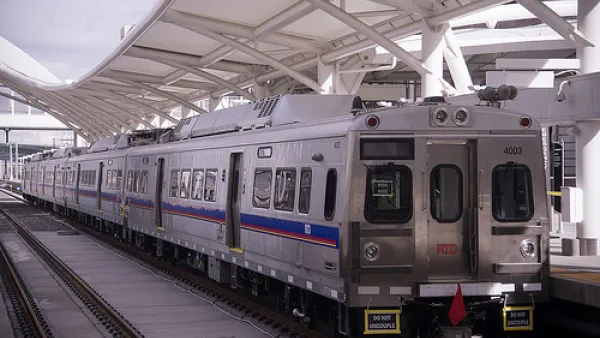
Denver Train Problems Caused by Tall Buildings: RTD
The A and G Lines use GPS for their crossing gates, they claim that a new software patch and other improvements would resolve those issues and put the G line on schedule.

A Planning Controversy of the Transit Oriented Variety in Suburban Denver
A controversy has erupted over a proposed vision for transit oriented mixed in a Denver suburb.
The Reviews Are In: Denver's West Rail Line
After a year of operation, Denver's 12.1-mile West Rail Line has provoked an ambivalent public response.

Planetizen Federal Action Tracker
A weekly monitor of how Trump’s orders and actions are impacting planners and planning in America.

California plans to bury El Niño’s downpour
If the state plays its cards right, it may be able to store a billion acre-feet of El Niño’s water in aquifers.

Desperate measures: Advocates weigh draining Lake Powell to fill Colorado River
Draining the reservoir could reduce evaporation losses by a couple hundred thousand acre-feet.

Los Angeles just elected an urban planner as its mayor
Transportation analysts are optimistic that Raman will be more aggressive in addressing transit issues than Bass.

Mamdani’s pied-à-terre tax survives legal challenge
A panel of judges found that the plaintiffs failed to demonstrate injury as a result of New York City's implementation of the tax.

Eastern Nebraska is running out of electricity
Data centers and electrification are straining eastern Nebraska’s grid, throttling economic development.

FREE Course: Walkable City 1: Why Walkability?
After describing his path towards focusing on walkability as the essence of good planning, Jeff Speck marches through his five principal reasons for making more walkable places.
Reinventing Malls: Planning Alchemy—Turning Gray Fields Into Gold
The course focuses on the opportunities and imperatives that shape reinvention of mall sites.

City of Rosemead
Rutgers University, Edward J. Bloustein School of Planning and Public Policy
One Hundred Miles
University of Michigan School for Environment and Sustainability (SEAS)
Hunter College, City University of New York (CUNY)
The Architects Foundation
City of Cambridge
Montrose County
The Pocatello Development Authority