Data from the Federal Railroad Administration shows that rail is competing well (and mostly winning) against air to claim market share in eight major city-pairs, many outside of the traditionally strong Northeast Corridor.


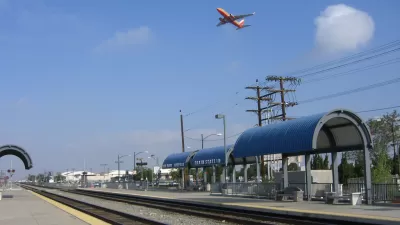
"Longer-distance intercity rail gets short shrift as a transportation mode in a lot of circles, often treated as more novelty than honest-to-god mobility solution," says Shane Phillips. "Air travel, on the other hand, is generally considered completely legitimate. In reality, even with relatively poor facilities by international standards--and massive federal investments in airport infrastructure--rail is competitive with air travel in much of the United States, and in some cases vastly more popular as this chart [from Amtrak] illustrates."
Phillips goes on to explain why this state of affairs is actually good for both Amtrak and airlines, and helps make the case for investment in High-Speed Rail.
Read the full story: Even with poor infrastructure, rail exceeds air market share in many domestic corridors
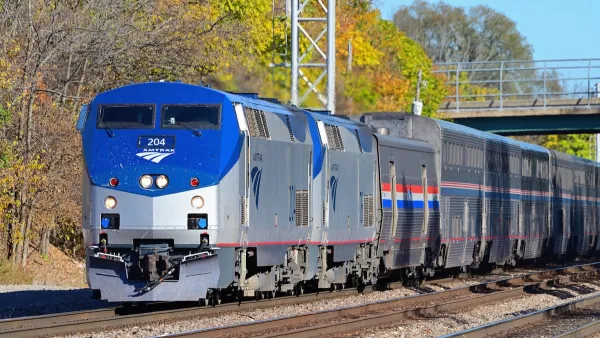
Amtrak Cutting Jobs, Funding to High-Speed Rail
The agency plans to cut 10 percent of its workforce and has confirmed it will not fund new high-speed rail projects.
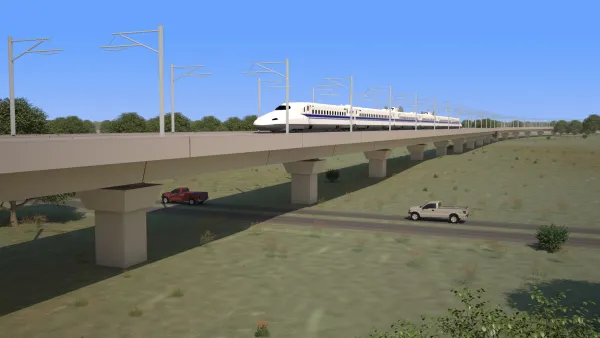
Texas High-Speed Rail Awarded $63.9M Federal Grant
In August, Amtrak received a $63.9 million grant from the FRA to continue its work to identify a high-speed rail corridor between Dallas and Houston.
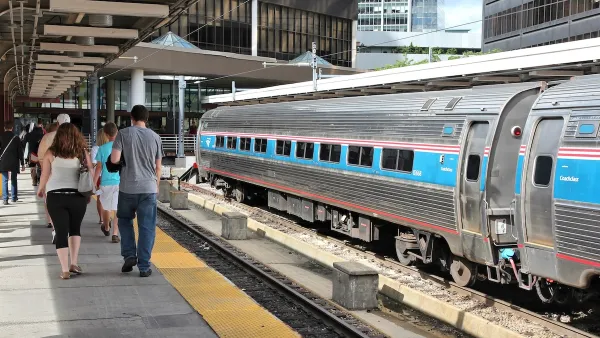
Proposed NYC-to-Boston HSR Would Cut Trip to Under Two Hours
The proposed project would use a mix of new and old rail lines and bypass some cities to speed up the trip.

Planetizen Federal Action Tracker
A weekly monitor of how Trump’s orders and actions are impacting planners and planning in America.

Eastern Nebraska is running out of electricity
Data centers and electrification are straining eastern Nebraska’s grid, throttling economic development.

Study reveals best places in the U.S. for cycling, walking
New research from Streetlight Data examines bicycle and pedestrian miles per capita in the 100 largest U.S. cities by population.

All sides of BRT debate unhappy with CDOT’s most recent move
The Colorado Department of Transportation is no longer considering center-running bus lanes for Colorado Boulevard.

Massachusetts bogs generate both power, and cranberries
Putting solar panels above farmland is one way Massachusetts is advancing toward its goal of net-zero carbon emissions by 2050.

What could the future of LA transit look like under Raman?
The mayor-elect views broken sidewalks and potholes as crises that can be fixed with better governance.

FREE Course: Walkable City 1: Why Walkability?
After describing his path towards focusing on walkability as the essence of good planning, Jeff Speck marches through his five principal reasons for making more walkable places.
Reinventing Malls: Planning Alchemy—Turning Gray Fields Into Gold
The course focuses on the opportunities and imperatives that shape reinvention of mall sites.

City of Rosemead
Rutgers University, Edward J. Bloustein School of Planning and Public Policy
One Hundred Miles
University of Michigan School for Environment and Sustainability (SEAS)
Hunter College, City University of New York (CUNY)
The Architects Foundation
City of Cambridge
The Pocatello Development Authority
The Urban Renewal Agency of the City of Pocatello