Governor Deval Patrick is set to unveil a key piece of his multi-billion dollar plan for reinvigorating Massachusetts' beleaguered transportation system: an $850 million expansion of congested South Station. Martine Powers describes the project.


This week, reports Powers, Patrick will brief State House leaders and committee leaders on his plan for renovating South Station, as "legislators begin to debate the tax increases he has proposed" to pay for his ambitious state-wide transportation plan. In the century since it opened, the station's footprint, and number of departures, has been reduced. The expansion, which "has been discussed for decades," would add at least 7 new tracks to the station's exiting 13.
"There are vocal critics of a South Station expansion," notes Powers. "But on the governor’s lengthy list of what many view as pipe dreams and long shots, the South Station expansion is one being pushed hardest — and one that is considered more likely than most to succeed."
"The proposed expansion would allow new service options — such as trains to Worcester, the South Coast Rail to Fall River and New Bedford, and a railroad to Cape Cod. Rapid-transit service along commuter rail lines would also be possible," adds Powers.
"Kairos Shen, chief planner at the Boston Redevelopment Authority, said increased train service at South Station could help to increase economic activity in the neighborhood, increasing access to burgeoning business growth downtown and in the South Boston seaport district, while also making those areas a more attractive option for new businesses."
“This not [sic] an infrastructure project for an infrastructure project’s sake,” Shen said. “There are major benefits for the long-term competitiveness of the city.”
Read the full story: An $850 million plan to return South Station to bygone glory
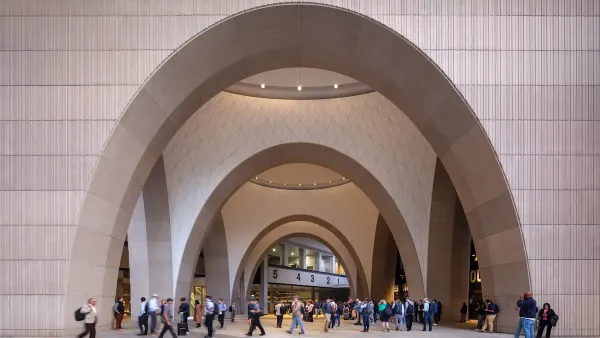
Boston Train Station Gets ‘Stunning’ Makeover
The historic South Station got some much-needed upgrades as part of a massive redevelopment project that will bring luxury condos and offices to the neighborhood.
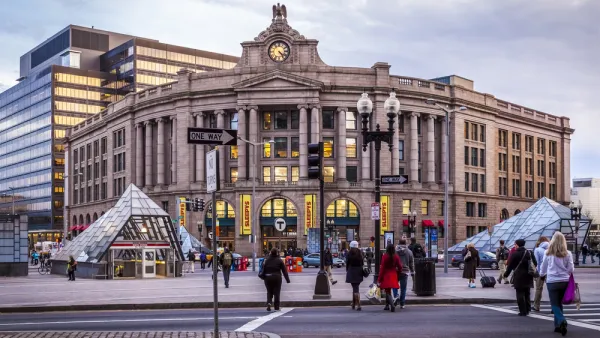
Plan Released for South Station Rail and Bus Terminal Expansion in Boston
A proposed expansion project is intended to expand passenger rail capacity around the Boston area.

Study reveals best places in the U.S. for cycling, walking
New research from Streetlight Data examines bicycle and pedestrian miles per capita in the 100 largest U.S. cities by population.

Planetizen Federal Action Tracker
A weekly monitor of how Trump’s orders and actions are impacting planners and planning in America.

Eastern Nebraska is running out of electricity
Data centers and electrification are straining eastern Nebraska’s grid, throttling economic development.
Study reveals best places in the U.S. for cycling, walking
New research from Streetlight Data examines bicycle and pedestrian miles per capita in the 100 largest U.S. cities by population.

Federal government nominates new FTA administrator
Mark Aesch is currently the founder and CEO of a transportation management consulting firm.

Developers reveal $10 billion stadium plan as ‘Hail Mary’ to keep Bears in Chicago
The plan would also boast a public park, high- and mid-rise buildings and a youth sports complex.

As Texas embraces carbon storage, a Black community questions the risks
Texas now issues permits for companies to store carbon dioxide underground. East Texas residents fear safety risks, and skeptics doubt the climate benefits.

FREE Course: Walkable City 1: Why Walkability?
After describing his path towards focusing on walkability as the essence of good planning, Jeff Speck marches through his five principal reasons for making more walkable places.
Reinventing Malls: Planning Alchemy—Turning Gray Fields Into Gold
The course focuses on the opportunities and imperatives that shape reinvention of mall sites.

City of Charlotte
City of Rosemead
Rutgers University, Edward J. Bloustein School of Planning and Public Policy
University of Michigan School for Environment and Sustainability (SEAS)
Hunter College, City University of New York (CUNY)
The Architects Foundation
City of Cambridge
The Pocatello Development Authority
The Urban Renewal Agency of the City of Pocatello