It's one of those news items that makes you ask: "Duh, what took you so long?" Los Angeles World Airports and the Metropolitan Transportation Authority are finally working together to identify how to connect LAX with the city's transit system.


As Yonah Freemark explained back in March, how to make what is probably the single most important transit connection in L.A. has flummoxed transit advocates and planners in the city for decades. Now, as reports, "[a]fter years of pursuing separate transportation plans for LAX, Los Angeles World Airports and the Metropolitan Transportation Authority now are working together to develop options for a rail stop that could tie the Green Line and the planned Crenshaw Line to the nation's third-busiest airport."
The best news: after initially planning a stop along the future Crenshaw Line that would have been located an eighth of a mile away from the airport, two of the four options now being considered are located inside the central terminal area.
"'Our work over the past six months has brought us light-years from where we were before,' said Paul Taylor, Metro's deputy chief executive, who noted that environmental clearances must be completed and funding secured before construction of an LAX station could begin."
The closest that rail transit currently comes to the airport is a stop along the Green Line that requires a connection to LAX via shuttle bus.
"Los Angeles County Supervisor and Metro board member Mark Ridley-Thomas, who has pushed for the Crenshaw Line, praised the effort and warned against repeating the mistake of stopping rail service short of the airport," notes Weikel.
Read the full story: Light rail plan for Los Angeles International Airport advances
As Transit Takes Off in LA, Making Sure LAX Doesn't Get Left Behind
A subject that has flummoxed transit advocates and planners in L.A. for decades is how to best connect to the city's largest airport. As planning advances for billions of dollars in transit projects, Yonah Freemark explores how best to make the link.
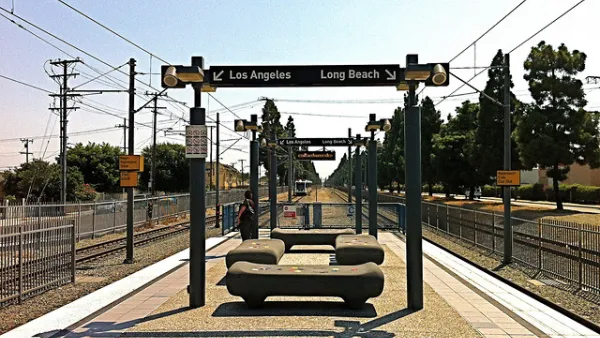
Major Temporary Closures Coming to Los Angeles Metro Rail
Metro will close several stretches of the Blue and Green lines as it completes $350 million worth of upgrades and opens the new Crenshaw Line. More than 100,000 daily riders may be inconvenienced.
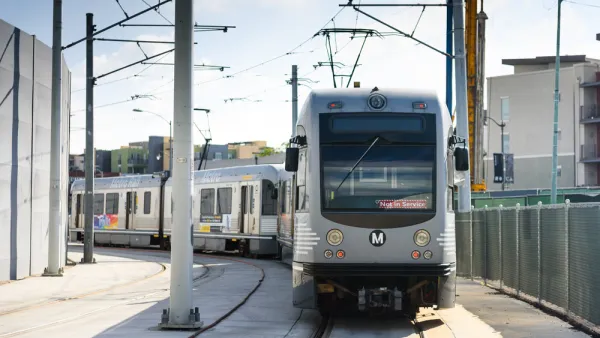
Planned L.A. Crenshaw Line Rollout Prompts Argument
Already delayed, the Crenshaw Line has now sparked debate between stakeholders who favor opposing visions of how the light rail service should link up with the existing Green Line.
Planetizen Federal Action Tracker
A weekly monitor of how Trump’s orders and actions are impacting planners and planning in America.

Eastern Nebraska is running out of electricity
Data centers and electrification are straining eastern Nebraska’s grid, throttling economic development.
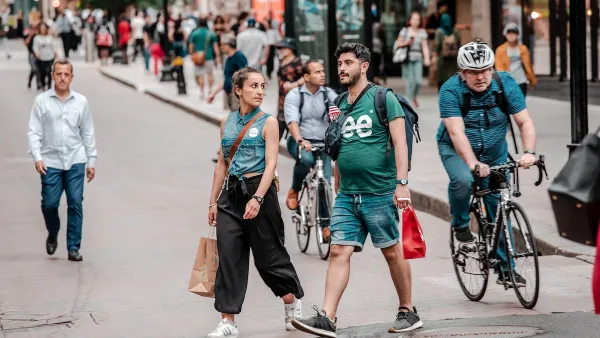
Study reveals best places in the U.S. for cycling, walking
New research from Streetlight Data examines bicycle and pedestrian miles per capita in the 100 largest U.S. cities by population.

DSA members accuse Mamdani of 'abandoning values' over housing redevelopment
New York City's mayor plans to replace about 2,000 units of public housing with private, mixed-income housing.

All sides of BRT debate unhappy with CDOT’s most recent move
The Colorado Department of Transportation is no longer considering center-running bus lanes for Colorado Boulevard.

Massachusetts bogs generate both power, and cranberries
Putting solar panels above farmland is one way Massachusetts is advancing toward its goal of net-zero carbon emissions by 2050.

FREE Course: Walkable City 1: Why Walkability?
After describing his path towards focusing on walkability as the essence of good planning, Jeff Speck marches through his five principal reasons for making more walkable places.
Reinventing Malls: Planning Alchemy—Turning Gray Fields Into Gold
The course focuses on the opportunities and imperatives that shape reinvention of mall sites.

City of Rosemead
Rutgers University, Edward J. Bloustein School of Planning and Public Policy
One Hundred Miles
University of Michigan School for Environment and Sustainability (SEAS)
Hunter College, City University of New York (CUNY)
The Architects Foundation
City of Cambridge
The Pocatello Development Authority
The Urban Renewal Agency of the City of Pocatello