Underlying President Obama's swamping the electoral college on election night were the demographic changes throughout the U.S. For the first time, Latinos voted in double-digits (10%). Republicans appear to have taken notice, but is it too late?


Four NBC reporters discuss the nation's demographic change that was an essential component to President Obama's re-election, accumulating 332 electoral votes to Romney's 206 (51% to 48% of popular vote), with Florida's vote determined on Nov. 10. The nation's voters have become increasing racially diverse and less white, and will only continue to do so. For the first time, the Census Bureau reports that 2011 saw 50.4% of all births be of color.
"What happened (Tuesday, Nov. 6) night was a demographic time bomb that had been ticking and that blew up in GOP faces. As the Obama campaign had assumed more than a year ago,
- the white portion of the electorate dropped to 72%, and the president won just 39% of that vote.
- he carried a whopping 93% of black voters (representing 13% of the electorate),
- 71% of Latinos (representing 10%)
- 73% of Asians (3%)
Obama's demographic edge creates this dilemma for the Republican Party: It can no longer rely on white voters to win national elections anymore."
Obama's demographic edge went beyond the nation' growing racial and ethnic minorities but extended to inevitable generational changes.
"(D)espite all the predictions that youth turnout would be down, voters 18-29 made up 19% of last night's voting population -- up from 18% four years ago -- and President Obama took 60% from that group. "
On the PBS NewsHour on Nov. 08, Jeffrey Brown moderated a panel composed of three Republican strategists to answer the question, "Will the Republican Party Learn to Adapt and Appeal to a Changing Electorate?"
JEFFREY BROWN: "Simple question: What is the number-one lesson Republicans should take from Tuesday's election?"
LESLIE SANCHEZ: "Most importantly, the GOP has failed to adjust to the American demographic realignment, (and particularly Hispanic voters)."
Repeating that theme, Washington Post columnist George Will opines on Nov. 07 that "the Republican Party...is endangered by tardiness in recognizing demography is destiny."
"It is surprising that only about 70 percent of Hispanics opposed Romney", quips Will in referencing Romney's assertion to encourage "illegal immigrants into 'self-deportation'."
It should be noted that George Will predicted a win for Romney - with 321 electoral votes to 217 for Obama.
According to the Washington Post, the decline in "the white share of the electorate continued, dropping to 72 percent, down from 74 percent in 2008 and 77 percent in 2004, according to exit polls."
Thanks to Mark Boshnack
Read the full story: First Thoughts: Obama's demographic edge
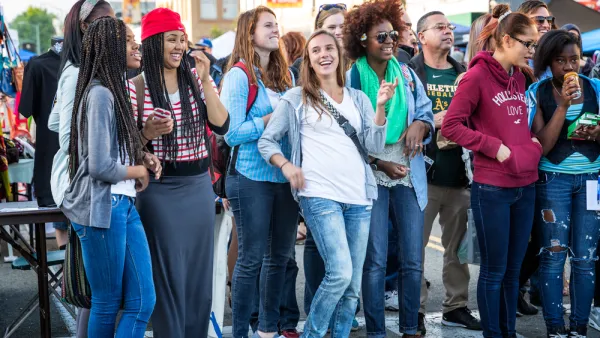
Minorities Have Dominated Millennial Urban Growth
Despite the impression that young white people have reshaped cities' demographics, research shows that non-white Millennials account for the greater part of that growth.
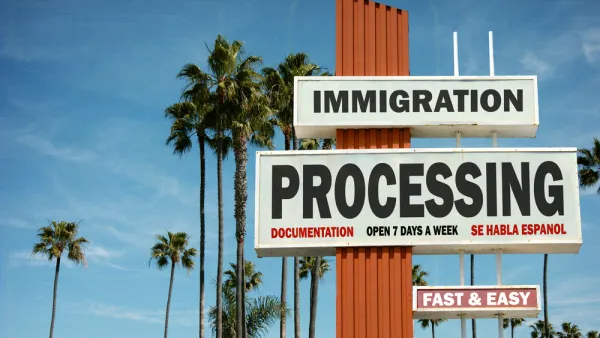
Hispanic Population Growth and Dispersion Slowed Since 2007
A comprehensive study on Latino population growth in the U.S. has been released by Pew Research Center based on a study of 2007-2014 census data. Two factors are responsible for the slowing growth: reduced fertility and immigration rates.
The Demographics of Pedestrian Safety
While pedestrian safety affects all areas, it disproportionately affects cities with large minority populations because they are more likely to walk than whites. Santa Ana, Calif. a majority "minority" city, is taking steps to make walking safer.

Planetizen Federal Action Tracker
A weekly monitor of how Trump’s orders and actions are impacting planners and planning in America.

Eastern Nebraska is running out of electricity
Data centers and electrification are straining eastern Nebraska’s grid, throttling economic development.

Study reveals best places in the U.S. for cycling, walking
New research from Streetlight Data examines bicycle and pedestrian miles per capita in the 100 largest U.S. cities by population.

Developers reveal $10 billion stadium plan as ‘Hail Mary’ to keep Bears in Chicago
The plan would also boast a public park, high- and mid-rise buildings and a youth sports complex.

As Texas embraces carbon storage, a Black community questions the risks
Texas now issues permits for companies to store carbon dioxide underground. East Texas residents fear safety risks, and skeptics doubt the climate benefits.

New BLM proposal would slash public comment periods, environmental protections
The proposed rewrite would also strip legal leverage from Tribal nations and state governments.

FREE Course: Walkable City 1: Why Walkability?
After describing his path towards focusing on walkability as the essence of good planning, Jeff Speck marches through his five principal reasons for making more walkable places.
Reinventing Malls: Planning Alchemy—Turning Gray Fields Into Gold
The course focuses on the opportunities and imperatives that shape reinvention of mall sites.

City of Rosemead
Rutgers University, Edward J. Bloustein School of Planning and Public Policy
One Hundred Miles
University of Michigan School for Environment and Sustainability (SEAS)
Hunter College, City University of New York (CUNY)
The Architects Foundation
City of Cambridge
The Pocatello Development Authority
The Urban Renewal Agency of the City of Pocatello