Joining a host of other Midwestern cities establishing land banks to help corral, clear, and repurpose their vacant properties, Kansas City will begin transferring 3,500 vacant properties it recently acquired into a city-owned land bank.


Already responsible for more than $1.5 million in yearly upkeep costs for the properties that were formerly owned by the financially strapped Jackson County Land Trust, Kansas City began acquiring 3,500 vacant properties this month as the "latest step in a plan to restore blighted communities in the city's core," reports Sarah Fentem.
"David Park of the Kansas City Planning Department said the transfer not
only provides more funds, but also offers the city 'more flexibility and
authority' when dealing with the vacant properties. For example, unlike
the Jackson County Land Trust, the city has the ability to give
properties away or combine two smaller properties to make the land more
marketable," notes Fentem.
"[Park] said he hopes such initiatives will attract younger people to Kansas
City. 'The idea of moving into a neighborhood that needs
revitalization-to be part of that movement- is attractive,' said Park.
New residents could help reduce blight by encouraging positive
redevelopment. 'I don't think we can cause it, but I think we can
facilitate it.'"
Read the full story: Take it to the Bank
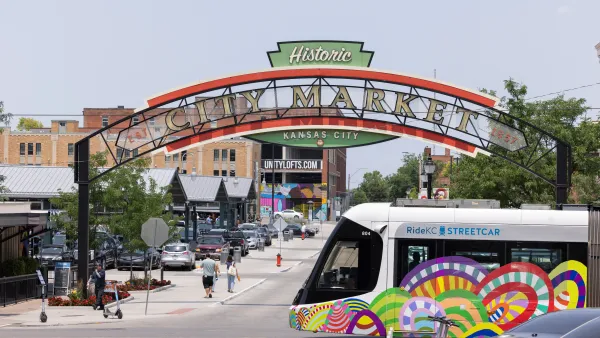
How Kansas City quietly built one of the best streetcars in America
A detailed and completely unbiased history of one of American transit's greatest comebacks.

In the 1990s, Kansas City's Womontown offered queer women community and independence
A group of women created a safe space that gave them the opportunity to buy homes and build wealth in a supportive community.
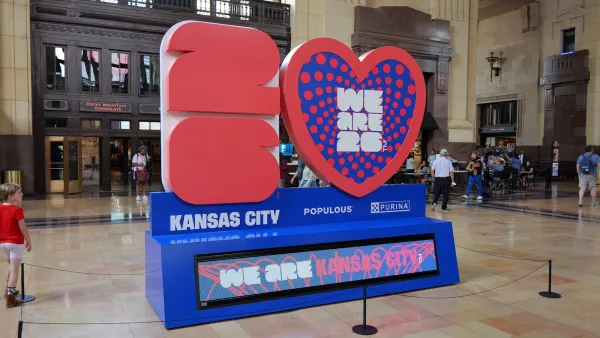
World Cup crowds offer 'stress test' for Kansas City transit planners
Transportation officials are closely monitoring travel patterns during the World Cup to understand how the city's transit system can be improved as the population grows.

Planetizen Federal Action Tracker
A weekly monitor of how Trump’s orders and actions are impacting planners and planning in America.

Eastern Nebraska is running out of electricity
Data centers and electrification are straining eastern Nebraska’s grid, throttling economic development.

Study reveals best places in the U.S. for cycling, walking
New research from Streetlight Data examines bicycle and pedestrian miles per capita in the 100 largest U.S. cities by population.

Why does it take an emergency for the U.S. to expedite infrastructure projects?
In June 2023, Philadelphia repaired a melted interstate in 12 days thanks to an emergency order.

Federal government nominates new FTA administrator
Mark Aesch is currently the founder and CEO of a transportation management consulting firm.

Developers reveal $10 billion stadium plan as ‘Hail Mary’ to keep Bears in Chicago
The plan would also boast a public park, high- and mid-rise buildings and a youth sports complex.

FREE Course: Walkable City 1: Why Walkability?
After describing his path towards focusing on walkability as the essence of good planning, Jeff Speck marches through his five principal reasons for making more walkable places.
Reinventing Malls: Planning Alchemy—Turning Gray Fields Into Gold
The course focuses on the opportunities and imperatives that shape reinvention of mall sites.

City of Charlotte
City of Rosemead
Rutgers University, Edward J. Bloustein School of Planning and Public Policy
University of Michigan School for Environment and Sustainability (SEAS)
Hunter College, City University of New York (CUNY)
The Architects Foundation
City of Cambridge
The Pocatello Development Authority
The Urban Renewal Agency of the City of Pocatello