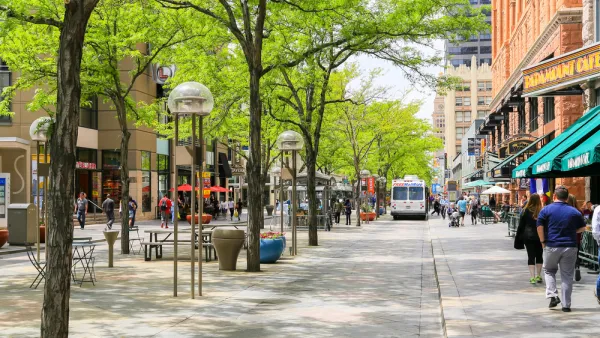
Jack Healy explores Denver's conflicted relationship with its 16th Street Mall, the pedestrian-oriented street that runs for a mile through the city's downtown. Bustling by day, but deserted and dicey at night, it has become an icon of the city.


In a city that lacks a singular iconic image or place, the city's "melting pot" has become one of its most recognizable symbols, for better or for worse, only thirty years after opening.
"Unlike attempts by other cities to revive their downtowns by closing
major streets to traffic, Denver scored a major success and created a
new public square with its 16th Street Mall," says Healy. "It draws map-carrying
tourists, badge-wearing conventioneers and white-collar workers, all
weaving through a sprawling circus of buskers and petitioners,
transients, sunglass sellers and street artists. Each year, about 16
million people ride the free shuttle buses that carry people along it."
"'This is our iconic image,' the mayor, Michael B. Hancock, said on
Tuesday morning as he slipped on an 'I ♥ 16th Street Mall' T-shirt. 'It's the heart and soul of our downtown. This really is our identity.'"
Read the full story: Denver, Searching for Icon, Celebrates Downtown Mall
The Past and Future of Pedestrian Malls
Pedestrian malls, a common urban design goal of the 1960s and 1970s have so fallen out of fashion that failed examples from history are cited as boogeyman like "bridges to nowhere" and "big digs."
Denver's 16th Street Mall Rehabilitation Proposal
At 27 years old, Denver's 16th Street Mall is in need of an upgrade. A team of consultants has recently released their recommendation of what needs to be done to rehabilitate one of Denver's premier public spaces.
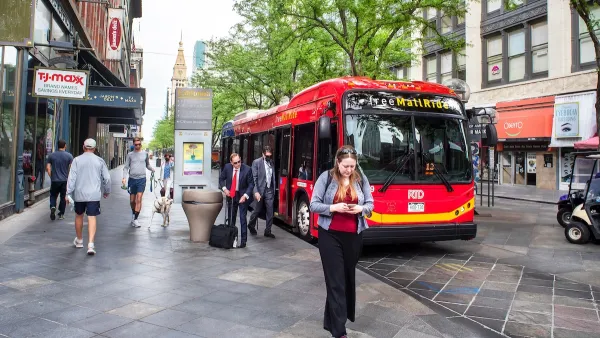
One of Denver’s busiest corridors to gain BRT
The project will span 18 miles and contain 74 bus rapid transit stations.

Planetizen Federal Action Tracker
A weekly monitor of how Trump’s orders and actions are impacting planners and planning in America.

Eastern Nebraska is running out of electricity
Data centers and electrification are straining eastern Nebraska’s grid, throttling economic development.

Study reveals best places in the U.S. for cycling, walking
New research from Streetlight Data examines bicycle and pedestrian miles per capita in the 100 largest U.S. cities by population.

DSA members accuse Mamdani of 'abandoning values' over housing redevelopment
New York City's mayor plans to replace about 2,000 units of public housing with private, mixed-income housing.

All sides of BRT debate unhappy with CDOT’s most recent move
The Colorado Department of Transportation is no longer considering center-running bus lanes for Colorado Boulevard.

Massachusetts bogs generate both power, and cranberries
Putting solar panels above farmland is one way Massachusetts is advancing toward its goal of net-zero carbon emissions by 2050.

FREE Course: Walkable City 1: Why Walkability?
After describing his path towards focusing on walkability as the essence of good planning, Jeff Speck marches through his five principal reasons for making more walkable places.
Reinventing Malls: Planning Alchemy—Turning Gray Fields Into Gold
The course focuses on the opportunities and imperatives that shape reinvention of mall sites.

City of Rosemead
Rutgers University, Edward J. Bloustein School of Planning and Public Policy
One Hundred Miles
University of Michigan School for Environment and Sustainability (SEAS)
Hunter College, City University of New York (CUNY)
The Architects Foundation
City of Cambridge
The Pocatello Development Authority
The Urban Renewal Agency of the City of Pocatello