At under a mile, L.A.'s first official "bike-friendly street" isn't going to transform the commuting habits of many Angelenos. Nevertheless, as an example of the city's new attitude to bicycling, recent improvements to Yucca Street are worth noting.


The LA Weekly's resident critic of all transportation non-automotive, Alissa Walker, reviews the changes that have transformed Yucca Street, as it runs through Hollywood, from "a good street for biking into a great one."
While not a part of city's ambitious 2010 Bicycle Plan, Yucca Street already boasted traffic diverting elements to keep motorists from using it as a shortcut, thus making it the ideal "low-hanging fruit" for creating the city's first official "bike-friendly street."
So while the $200,000 in improvements (including street repairs) didn't transform the street, they're certainly welcome upgrades for cyclists. "In addition to
"sharrows" (those painted bike icons on the asphalt), the curbs at each
diverter (the median-like strips sticking into the intersection to
divert cars) had been cut into paths just wide enough for a bike," explains Walker. "A sign
above each diverter amends the 'Right Turn Only' message to autos with
an 'Except Bicycles' disclaimer."
"This detail might not be obvious to a driver, so new signage
signals to everyone that Yucca is different. Small green bike icons
have been affixed to the top of each Yucca street sign, a massive
aesthetic improvement over the 'Bike Route' signs you see on most
streets, which are usually tacked like an afterthought in places that
are easy for drivers (and bikers) to miss."
"It's a tiny gesture, yes," says Walker, "but it's the equivalent of the red carpet to a
cyclist in L.A., where we have so little 'bikes only' real estate."
Read the full story: L.A.'s First Official Bike-Friendly Street: Our Review

Los Angeles just elected an urban planner as its mayor
Transportation analysts are optimistic that Raman will be more aggressive in addressing transit issues than Bass.
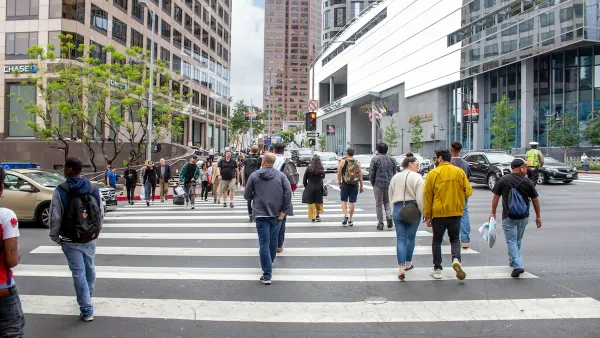
LA residents may be allowed to paint their own crosswalks
Councilwoman Katy Yaroslavsky put out a motion instructing the Los Angeles Department of Public Transportation to study the feasibility of allowing volunteers to paint crosswalks.
Not in my parking spot: LA renters oppose ADU development in their garages
Some tenants advocates say taking away residents’ parking spaces harms senior citizens and people with disabilities who rely on their cars to navigate the city.

Desperate measures: Advocates weigh draining Lake Powell to fill Colorado River
Draining the reservoir could reduce evaporation losses by a couple hundred thousand acre-feet.

Eastern Nebraska is running out of electricity
Data centers and electrification are straining eastern Nebraska’s grid, throttling economic development.

Move over, LA: St. Louis gears up for Olympics, invests millions in downtown redevelopment
The Missouri city will host the 2028 Olympic soccer group stage and knockout matches.

Mass. votes against statewide minimum lot size for single-family homes
Over 2 million residents voted on Question 7; it was decided by just over 30,000 votes.

Maryland’s $15 billion bridge project gains key approval
The Maryland Transit Authority said the project will create over 60,000 jobs and add $23 billion to the local economy.

‘No clear next steps’ for Chicago's permanent festival grounds
Eleventh Ward Ald. Nicole Lee has suggested Soldier Field as a possible location for the permanent event space.

FREE Course: Walkable City 1: Why Walkability?
After describing his path towards focusing on walkability as the essence of good planning, Jeff Speck marches through his five principal reasons for making more walkable places.
Reinventing Malls: Planning Alchemy—Turning Gray Fields Into Gold
The course focuses on the opportunities and imperatives that shape reinvention of mall sites.

City of Rosemead
Rutgers University, Edward J. Bloustein School of Planning and Public Policy
One Hundred Miles
University of Michigan School for Environment and Sustainability (SEAS)
Hunter College, City University of New York (CUNY)
The Architects Foundation
City of Cambridge
Montrose County
The Pocatello Development Authority