While the housing crash may have temporarily halted the dramatic growth in downtown LA's residential sector, new retail and restaurant openings continued. Now, as the housing market recovers, developers are clawing to get back to building residences.


"'The rental market, it's amazing,' said Shy, who already owns some 1,200
apartments in five Downtown buildings. 'I have no vacancy and the rent
keeps going up.'"
"He is far from alone," says Vaillancourt. "A chorus of experienced Downtown developers are
all responding to current market conditions: Central City apartment
occupancy is at an all-time high, with some area landlords reporting
that their buildings are about 98% full."
With 28,861 housing units reportedly located in downtown at the start of 2012, many don't think the projected growth over the next few years (8%) will do much to alleviate soaring prices.
"[Tom] Gilmore, one of the first modern era developers to build housing in
the Downtown core, said the units forecast to come online in the next
few years represent a drop in the ocean, chiefly because the area
remains home to some 500,000 jobs. The residential population is
estimated to be around 50,000," notes Vaillancourt.
"You have to always go back to the fundamental math
of how many jobs are there versus how much housing, and the ratio is
still way out of whack," Gilmore said. "We could probably use 200,000
more units of housing."
Read the full story: The Next Downtown Apartment Boom
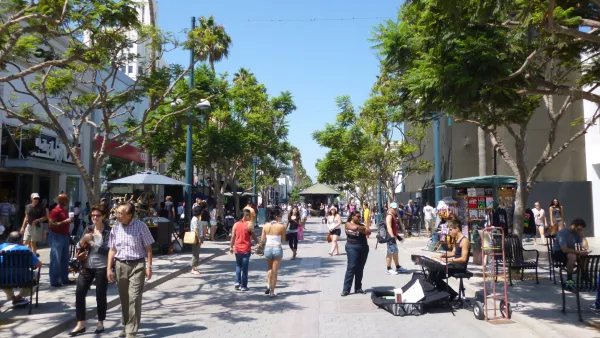
Businesses Oppose Conversion of Parking Structure Into Affordable Housing
Business owners in downtown Santa Monica have filed a lawsuit opposing the city's planned replacement of a parking structure with housing, despite city studies showing that the city's downtown parking supply far exceeds demand.
Report Finds Historically Unaffordable Rents
A new report from Zillow shows evidence of a deepening crisis in the rental housing market.
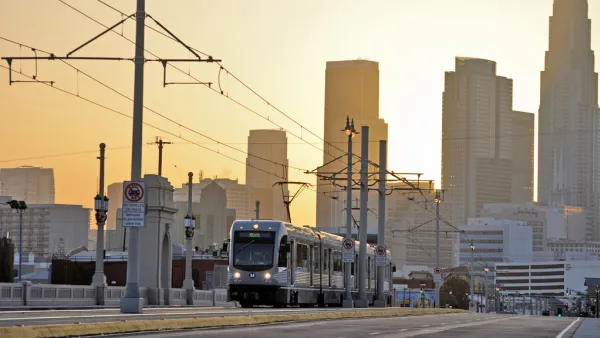
Where Los Angeles Equals San Francisco's Density
Though the Los Angeles region is very dense, significant barriers to transit-oriented planning remain. Based on this analysis, the lack of a central urban core shouldn't be one of them.

Planetizen Federal Action Tracker
A weekly monitor of how Trump’s orders and actions are impacting planners and planning in America.

California plans to bury El Niño’s downpour
If the state plays its cards right, it may be able to store a billion acre-feet of El Niño’s water in aquifers.

Desperate measures: Advocates weigh draining Lake Powell to fill Colorado River
Draining the reservoir could reduce evaporation losses by a couple hundred thousand acre-feet.

Mamdani’s pied-à-terre tax survives legal challenge
A panel of judges found that the plaintiffs failed to demonstrate injury as a result of New York City's implementation of the tax.

Eastern Nebraska is running out of electricity
Data centers and electrification are straining eastern Nebraska’s grid, throttling economic development.

Seattle passes record-breaking transit services expansion
Proposition 1 will double the city’s transit tax to add 95,000 more bus trips and preserve 180,000 bus trips annually.

FREE Course: Walkable City 1: Why Walkability?
After describing his path towards focusing on walkability as the essence of good planning, Jeff Speck marches through his five principal reasons for making more walkable places.
Reinventing Malls: Planning Alchemy—Turning Gray Fields Into Gold
The course focuses on the opportunities and imperatives that shape reinvention of mall sites.

City of Rosemead
Rutgers University, Edward J. Bloustein School of Planning and Public Policy
One Hundred Miles
University of Michigan School for Environment and Sustainability (SEAS)
Hunter College, City University of New York (CUNY)
The Architects Foundation
City of Cambridge
Montrose County
The Pocatello Development Authority